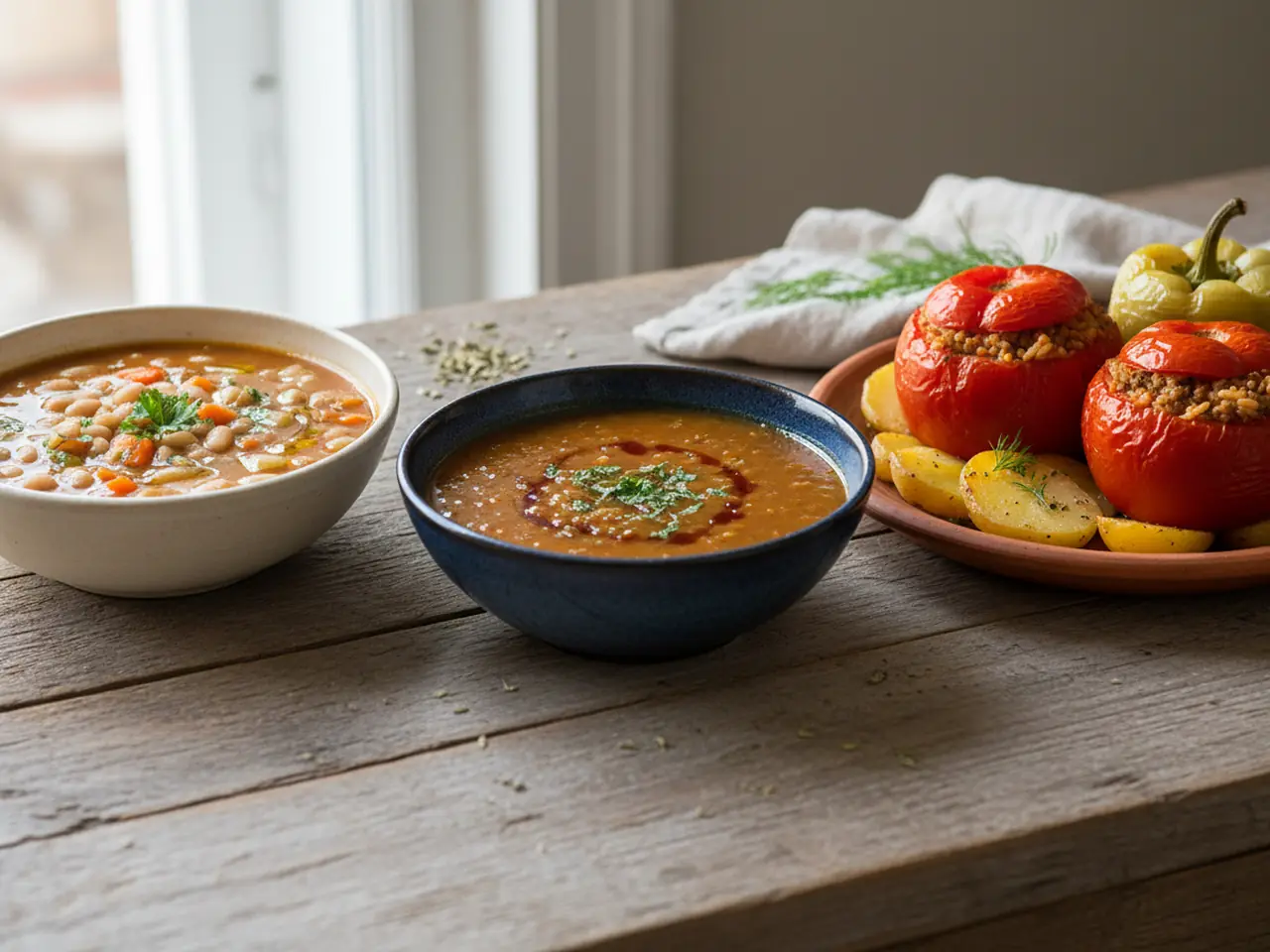
In MesogeaFit's recipes, a portion of a cooked dish has 150 to 640 kcal. Most pulse dishes and ladera (vegetables slow-cooked in olive oil) fall between 330 and 430. A 470 g portion of Fasolada (Greek bean soup) has about 400 kcal, Fakes (lentil soup) 320 and Gemista (stuffed tomatoes and peppers) with potatoes about 510. Three things change the calories more than anything else: the oil in the pot, the size of the plate and what you eat on the side.
If you search online for ‘how many calories are in fasolada’, you will find very different numbers. Many of them may be correct, because they measure different things. Here you will find the calories for the 36 cooked dishes in our recipes, how we calculate them and what changes them on your own plate.
How we calculate a cooked dish
A home-cooked dish has no label, so its calories are calculated from the ingredients. We follow the method of EuroFIR, the European network for food composition databases:
- We list every ingredient in the pot raw, at its edible weight: the beans dry, the vegetables cleaned, the oil, the tomato.
- We add up their nutrients from the Ciqual and USDA databases.
- We work out how much the dish weighs once cooked. Pulses absorb water and get heavier, while ladera and roasted dishes lose water and get lighter. For this we use cooking yield factors. Most of them come from the Ciqual and USDA databases, and the one for Gemista from a published table. For a few dishes, such as minced beef sauce, they are our own estimate.
- We divide by the number of portions in the recipe.
EuroFIR itself says that calculating from a recipe is a model and that the results are approximations. In practice, the calories per portion are fairly accurate, because the pot is divided into the same portions. The grams per portion are an estimate, because each pot holds a different amount of water. That is why the app has a ‘Weigh the pot’ button.
All the cooked dishes in one table
Portion = the whole pot divided by the number of servings in our recipe. Tap a column heading to sort.
Pulses and ladera give 270 to 430 kcal per portion, and Gemista with their potatoes about 510. Dishes with meat or fish vary more, from 257 kcal for prawns in tomato sauce to 640 for pastitsio. The table shows only the dish from the pot. In the app's meals, bread, feta or salad are added, and the whole meal has 420 to 710 kcal.
How much the oil changes the calories
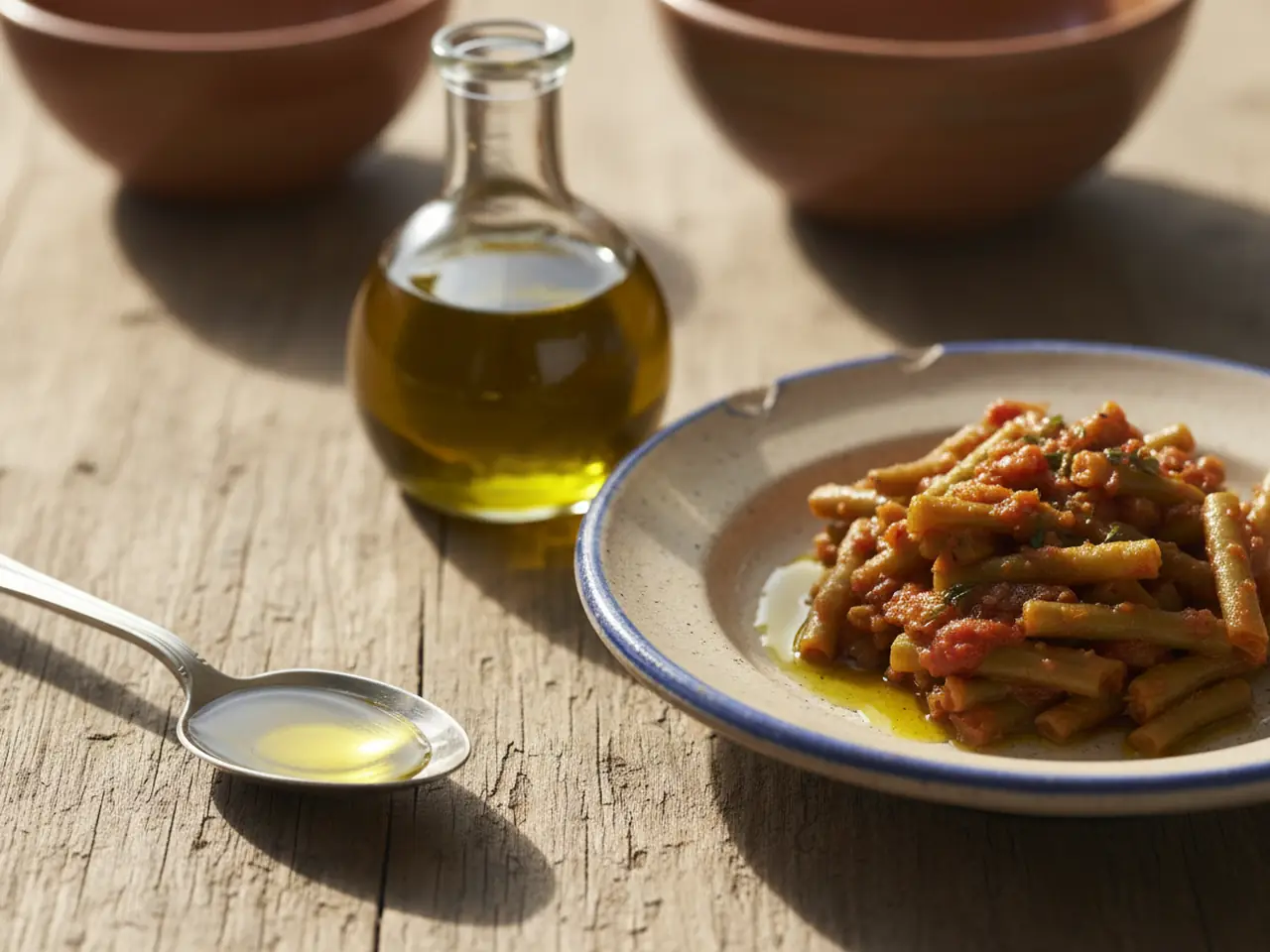
In our recipes the oil is measured, 5 tablespoons for 6 portions of Fasolada and a third of a cup for 4 portions of Fasolakia (green beans in olive oil). That is less than many traditional recipes use. See what happens if only the oil changes:
| Recipe | Oil in the pot | kcal per portion |
|---|---|---|
| Fasolada, 6 portions | no oil | about 294 |
| Fasolada, 6 portions | 5 tbsp (our recipe) | about 397 |
| Fasolada, 6 portions | half a cup | about 459 |
| Fasolada, 6 portions | one cup | about 624 |
| Fasolakia, 4 portions | no oil | about 183 |
| Fasolakia, 4 portions | a third of a cup (our recipe) | about 348 |
| Fasolakia, 4 portions | one cup | about 678 |
In the app's ladera, the oil provides roughly a third to almost two thirds of the calories in a portion. This does not make ladera ‘bad’ food. It means that the oil, together with the size of the plate, is one of the things that vary most from one home to another. More in the article on olive oil and ladera.
The size of the plate
The Fasolada in our recipe has about 85 kcal per 100 g. The same dish gives very different calories depending on the plate:
| Plate of Fasolada | Energy | Protein |
|---|---|---|
| 300 g | 254 kcal | 13 g |
| 350 g | 296 kcal | 16 g |
| 470 g (one portion of the recipe) | 398 kcal | 21 g |
| 600 g | 508 kcal | 27 g |
If you don't have kitchen scales, measure once how much the plate you usually use holds. Then you will know how much you eat each time.
What you eat on the side
| Side | Energy | Salt |
|---|---|---|
| Feta 30 g (a piece the size of a matchbox) | 85 kcal | 0.7 g |
| Feta 50 g | 142 kcal | 1.1 g |
| Wholemeal bread, 1 slice, 30 g | 70 kcal | 0.4 g |
| White bread, 2 slices, 60 g | 172 kcal | 0.8 g |
| Kalamata olives, 4 | 28 kcal | 0.3 g |
| Kalamata olives, 10 | 69 kcal | 0.7 g |
The app's meal Fasolada with olives and bread has 398 kcal from the Fasolada, 70 from one slice of bread and 28 from 4 olives, 495 in total. If the one slice of bread becomes three and the olives become ten, the meal goes over 670 kcal.
Why you find other numbers online
- Per 100 g or per plate. Fasolada has about 85 kcal per 100 g but about 400 per plate.
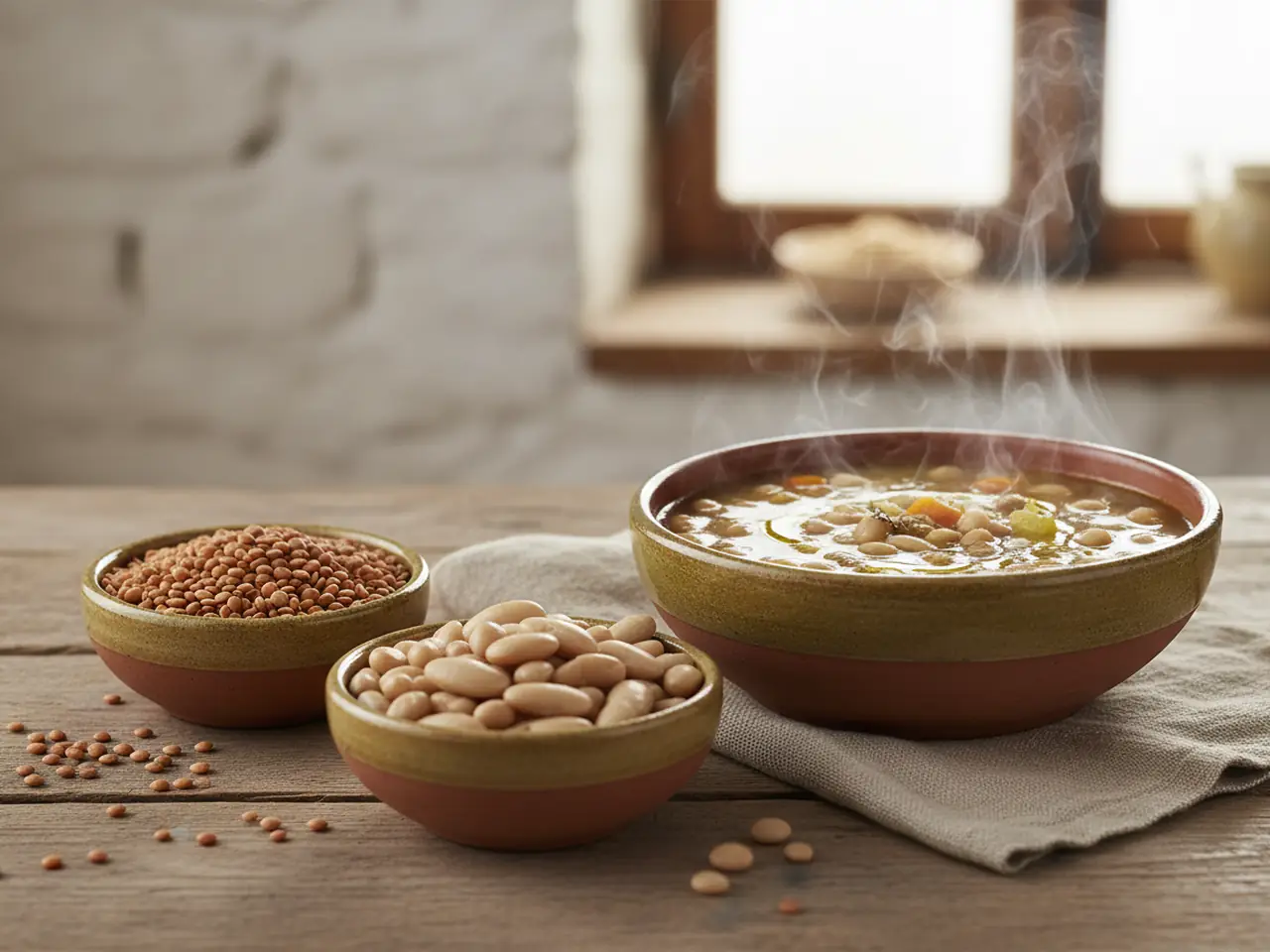
- Dry or boiled pulses. Dry beans have 307 kcal per 100 g and boiled beans 113. Many ‘300 calories’ figures refer to the dry pulse.
- How much oil goes into the pot, as you saw above.
- How big the plate is.
- How watery the dish is. This changes the calories per 100 g, but not the calories per portion, if the pot is divided into the same number of plates.
- What goes on the side: bread, feta, olives.
Cooked dishes and your weekly portions
The Greek National Dietary Guidelines for Adults (2014) count one plate of Fasolada as 2 portions of pulses. They count a 300 g plate of ladera, such as Arakas (peas in olive oil), Fasolakia or Bamies (okra in olive oil), as 2 portions of vegetables. A plate of Revithorizo (chickpeas with rice) counts as 1 portion. So two plates of Fasolada a week meet the guidelines' target of at least 3 portions of pulses. More in the article on pulses.
If you are watching your salt
The app's pulse and ladera meals have 1.0 to 2.0 g of salt each, most of them 1.4 to 1.8. Part of it comes from the dish itself and part from the feta, bread and olives served on the side. If your doctor has told you to cut down on salt, the side dishes are the easiest to reduce.
In the MesogeaFit app you choose the dish and the app works out how many grams fit into your meal. If your own recipe has a different amount of oil or a different number of portions, you can enter it with your own ingredients.
Sources
- Reinivuo H, Laitinen K (2007). Proposal for the harmonisation of recipe calculation procedures (EuroFIR D2.2.12). PDF
- Reinivuo H, Bell S, Ovaskainen ML (2009). Harmonisation of recipe calculation procedures in European food composition databases. Journal of Food Composition and Analysis 22(5):410-413. doi.org
- EuroFIR AISBL (Machackova M, Giertlova A, Porubska J) (2015). How to calculate nutrient content of foods: a guideline for food business operators. PDF
- USDA FoodData Central (2019). SR Legacy, food composition table. fdc.nal.usda.gov
- Machackova M et al. (2018). EuroFIR Guideline on calculation of nutrient content of foods for food business operators. Food Chemistry 238:35-41. PubMed 28867099
- Bognár A (2002). Tables on weight yield of food and retention factors of food constituents for the calculation of nutrient composition of cooked foods (BFE-R-02-03). Bundesforschungsanstalt für Ernährung, Karlsruhe.
- Institute of Preventive, Environmental and Occupational Medicine (Prolepsis) (2014). Greek National Dietary Guidelines for Adults (in Greek). PDF
- ANSES (2025). Ciqual food composition table. ciqual.anses.fr
Last checked: October 2026. This article gives general information for adults and does not replace advice from a doctor or dietitian. If you find a mistake, write to us at info@mesogeafit.com.
The amounts for your own meals
MesogeaFit works out the grams of each meal from your details and corrects them every 2 weeks from your weigh-ins.