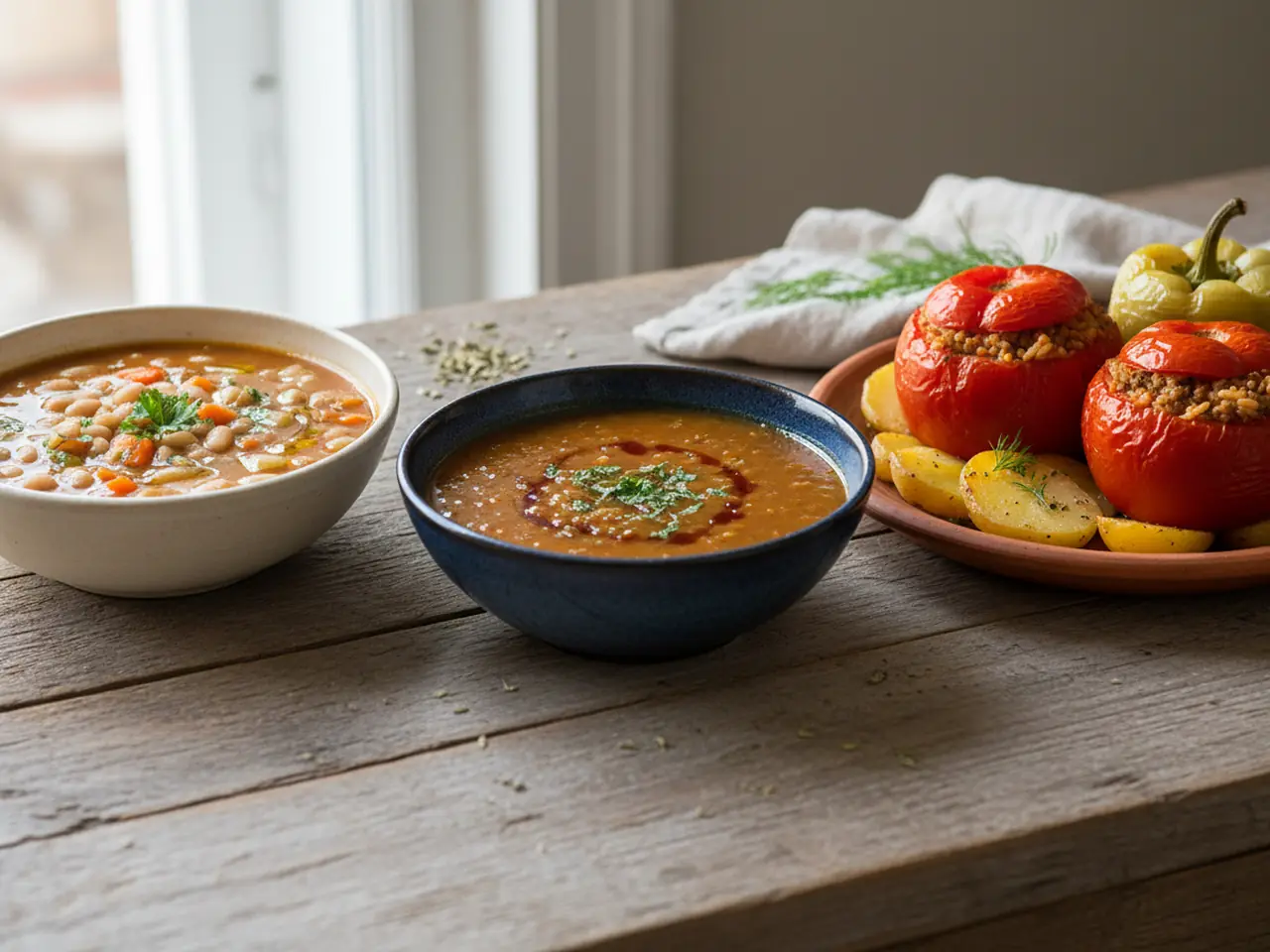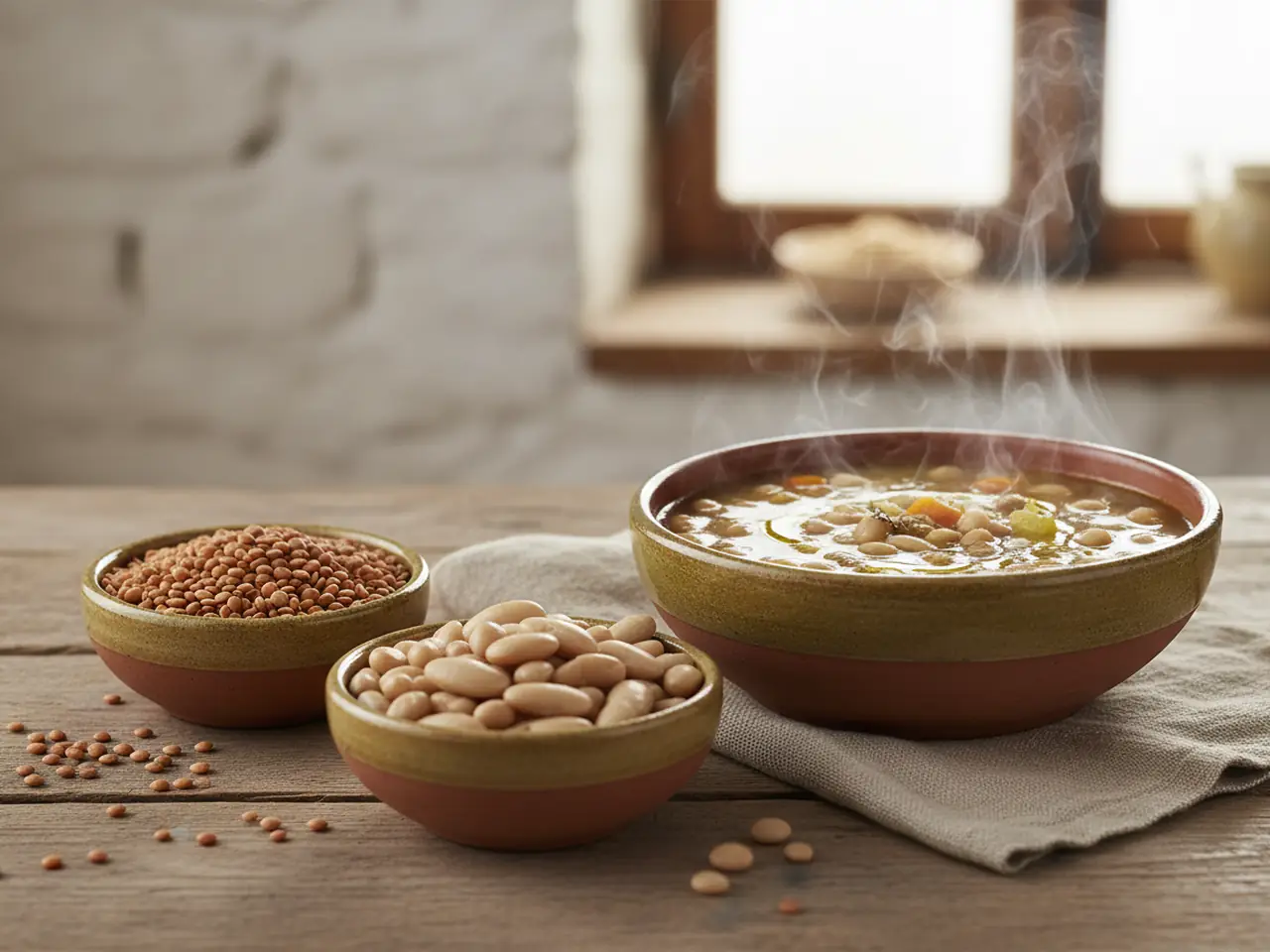
The Greek National Dietary Guidelines for Adults ask for at least 3 portions of pulses (legumes) a week. One portion is a cup of cooked pulses, about 150 to 200 g, and a plate of Fasolada (Greek bean soup) counts as two. Pulses provide protein and plenty of fibre with little fat. In trials, one portion a day lowered ‘bad’ cholesterol slightly, and perhaps weight slightly too.
Pulses are a core part of Greek cooking, from Fasolada (Greek bean soup) and lentils to chickpeas, giant beans and Fava (yellow split pea purée). The Greek National Dietary Guidelines for Adults (2014) give them a food group of their own, with its own weekly target. Below you will find exactly what the guidelines ask for, why, and what research has shown.
What the guidelines say exactly
The recommendation of the Greek National Dietary Guidelines for Adults (2014) is ‘Eat at least 3 portions of pulses a week’. The guidelines count portions, not times:
- 1 portion = 1 cup (240 ml) of cooked, drained pulses, about 150 to 200 g depending on the type.
- 1 plate of Fasolada = 2 portions.
- 1 plate of Revithorizo (chickpeas with rice) = 1 portion.
- 1 salad with lentils, rocket and tomato = 1 portion.
The group includes lentils, beans, chickpeas, fava and dried broad beans. The guidelines say pulses are rich in plant protein, carbohydrate, fibre, iron, calcium, magnesium and zinc, and are low in fat. They suggest choosing them especially during Orthodox fasting periods, and combining them with grains such as bread or rice for better-quality protein.
What one portion gives you
For boiled and drained pulses, with values from the app's database:
| Pulse, boiled | 150 g | 200 g |
|---|---|---|
| Lentils | 191 kcal, 15 g protein, 13 g fibre | 255 kcal, 20 g protein, 17 g fibre |
| Chickpeas | 221 kcal, 12 g protein, 12 g fibre | 295 kcal, 17 g protein, 16 g fibre |
| Beans | 169 kcal, 10 g protein, 21 g fibre | 226 kcal, 14 g protein, 28 g fibre |
| Fava | 193 kcal, 13 g protein, 12 g fibre | 258 kcal, 17 g protein, 16 g fibre |
| Black-eyed beans | 159 kcal, 12 g protein, 10 g fibre | 211 kcal, 15 g protein, 13 g fibre |
One portion gives 10 to 20 g of protein and about 10 g of fibre or more, about 40% of the 25 g an adult needs a day. The ‘300 calories per 100 g’ you often read about refers to dry pulses. Cooked, they have 106 to 148.
What research shows
Cholesterol. An analysis of 26 randomised trials with 1,037 people looked at what happens when you eat about 130 g of pulses every day, which is about one portion. LDL cholesterol, the ‘bad’ kind, fell by about 6.6 mg/dL on average compared with diets of the same calories without pulses. The fall is small and the trials lasted a few weeks. The finding is fairly certain.
Weight. An analysis of 21 trials with 940 people found that those who ate about one portion of pulses a day lost 0.34 kg more on average over about 6 weeks. The effect was also seen in the trials where calories were not reduced. The effect is very small and of low certainty. Pulses may help a little. In any case, in these trials pulses did not increase weight.
Fullness. In 9 small experimental studies, people who ate pulses felt about 30% fuller. At the next meal, however, they did not eat less. The finding is of low certainty.
There is one important detail. These trials gave one portion every day, about 7 a week. The guidelines ask for at least 3. We don't know whether 3 portions give the same result. What is certain is that they add protein and fibre to your diet with little fat.
How many pulses a meal in the app contains
We calculated the amount of cooked pulses in a portion of each pulse dish in our recipes:
| Meal | Cooked pulses per portion | Guideline portions | Protein per meal |
|---|---|---|---|
| Fasolada with olives and bread | about 223 g | 1.1 to 1.5 | 24 g |
| Fakes (lentil soup) with feta and bread | about 161 g | 0.8 to 1.1 | 24 g |
| Revithada (chickpea stew) with feta and bread | about 182 g | 0.9 to 1.2 | 23 g |
| Gigantes plaki (baked giant beans) with feta and bread | about 214 g | 1.1 to 1.4 | 25 g |
| Black-eyed beans with spinach, feta and bread | about 187 g | 0.9 to 1.2 | 26 g |
| Fakorizo (lentils with rice) with yoghurt and salad | about 128 g | 0.6 to 0.9 | 32 g |
Three pulse meals a week from our recipes come close to the guidelines' target or meet it, depending on the dish and your portion. So does one large plate of Fasolada plus a black-eyed bean salad. Fava with onion and hummus with vegetables add pulses to other meals of the day as well.
Bloating
In three US trials, participants ate half a cup of beans every day for 8 to 12 weeks. In the first week, fewer than half reported more wind. Of those, at least 7 in 10 said the problem passed within 2 to 3 weeks. These data are based on what the participants reported themselves, so they are of low certainty.
The Greek dietary guidelines suggest boiling pulses well and eating smaller amounts more often. They do not recommend adding bicarbonate of soda when soaking, because vitamins are lost. In a laboratory study, soaking reduced the sugars in pulses that cause wind by 10% to 40%, and boiling reduced them even more. Whether this also reduces symptoms has not been measured.
Who needs to be careful
- Irritable bowel syndrome. Pulses contain FODMAP carbohydrates, which often cause discomfort in this condition. Follow the advice of your doctor or dietitian.
- G6PD deficiency (favism). Avoid broad beans, fresh and dried. The ‘fava’ in our recipes is made from yellow split peas, not broad beans.
- Chronic kidney disease. Pulses contain potassium, phosphorus and protein. Follow your doctor's advice.
In the MesogeaFit app, pulses count towards the app's weekly pattern, which suggests at least 3 portions a week. For fasting days, also read the article on fasting and protein.
Sources
- Institute of Preventive, Environmental and Occupational Medicine (Prolepsis) (2014). Greek National Dietary Guidelines for Adults (chapter ‘Pulses’) (in Greek). PDF
- Ha V et al. (2014). Effect of dietary pulse intake on established therapeutic lipid targets for cardiovascular risk reduction: a systematic review and meta-analysis of randomized controlled trials. CMAJ 186(8):E252-E262. PubMed 24710915
- Kim SJ et al. (2016). Effects of dietary pulse consumption on body weight: a systematic review and meta-analysis of randomized controlled trials. American Journal of Clinical Nutrition 103(5):1213-1223. PubMed 27030531
- Li SS et al. (2014). Dietary pulses, satiety and food intake: a systematic review and meta-analysis of acute feeding trials. Obesity 22(8):1773-1780. PubMed 24820437
- Winham DM, Hutchins AM (2011). Perceptions of flatulence from bean consumption among adults in 3 feeding studies. Nutrition Journal 10:128. PubMed 22104320
- Njoumi S et al. (2019). Soaking and cooking modify the alpha-galacto-oligosaccharide and dietary fibre content in five Mediterranean legumes. International Journal of Food Sciences and Nutrition 70(5):551-561. PubMed 30614326
- Luzzatto L, Arese P (2018). Favism and glucose-6-phosphate dehydrogenase deficiency. New England Journal of Medicine 378:60-71. PubMed 29298156
Last checked: October 2026. This article gives general information for adults and does not replace advice from a doctor or dietitian. If you find a mistake, write to us at info@mesogeafit.com.
The amounts for your own meals
MesogeaFit works out the grams of each meal from your details and corrects them every 2 weeks from your weigh-ins.