The European Food Safety Authority (EFSA) sets 0.83 g of protein per kilo of body weight a day as the minimum for healthy adults. When you lose weight, more protein may help you keep muscle, although the evidence is of low certainty. In the MesogeaFit app the target is 1.2 g per kilo if you don't exercise, 1.4 to 1.6 with recreational exercise and 1.6 to 2.2 if you lift weights. For 70 kg this means 84 to 154 g a day. At each main meal the target is 0.3 to 0.4 g per kilo, at least 20 to 25 g. If you have kidney disease, different rules apply.
There are two numbers for protein. One is the minimum for health. The other is the amount that probably helps you more when you are losing weight or exercising. Below you will find both, and where the protein is on your table.
The minimum for health
The European Food Safety Authority (EFSA, 2012) sets the following for healthy adults:
- 0.66 g per kilo a day as the average requirement,
- 0.83 g per kilo a day as the amount that covers almost everyone.
For someone weighing 70 kg, 0.83 g per kilo is 58 g a day. EFSA did not set an upper limit, because there was not enough evidence. It says that amounts up to twice as high are often eaten in Europe and are considered safe. The Greek National Dietary Guidelines for Adults (2014) give the same numbers. This is the minimum for health. For dieting or training the targets are higher, as you will see below.
Why more when you are losing weight
An analysis of 24 randomised trials with 1,063 adults compared diets with more protein and diets with the usual amount, at the same calories, for about 12 weeks. With more protein, participants lost 0.79 kg more weight and 0.87 kg more fat, and kept 0.43 kg more fat-free mass. A 2024 review by the German Nutrition Society judged the evidence insufficient because of the quality of the studies. The benefit may exist and is small, and the evidence is of low certainty. A 2015 review, funded by industry, suggests 1.2 to 1.6 g per kilo and 25 to 30 g at each meal.
If you lift weights
An analysis of 49 trials with 1,863 healthy adults found that protein supplements, together with weight training, added a little fat-free mass, about 0.3 kg, and a little strength. The benefit stopped increasing once total protein for the day reached around 1.6 g per kilo. The researchers say that 2.2 g per kilo is a sensible amount for anyone who wants the maximum. The finding is fairly certain. Most of the participants, however, were not dieting.
In small trials of people in a large deficit, more protein helped prevent the loss of fat-free mass. In one of them, 1.6 g per kilo protected as well as 2.4. One trial had 40 young men on a deficit of about 40%, training 6 days a week for 4 weeks. Those taking 2.4 g per kilo gained 1.2 kg of fat-free mass, while those taking 1.2 g gained almost none. The trials were small and short, so they are of low certainty.
MesogeaFit's targets
| Situation | Per kilo a day | For 70 kg |
|---|---|---|
| EFSA minimum | 0.83 g | 58 g |
| No exercise | 1.2 g | 84 g |
| Recreational exercise | 1.4 to 1.6 g | 98 to 112 g |
| Weights | 1.6 to 2.2 g | 112 to 154 g |
| After 65 | at least 1.0 to 1.2 g | 70 to 84 g |
The app never goes above 2.2 g per kilo, and only goes above 1.66 if you lift weights.
If you have a lot of weight to lose, the target is not calculated from your full weight. When body mass index (BMI) is above 30, the app uses the weight you would have at a BMI of 30. For someone 1.70 m tall weighing 110 kg, that is about 87 kg, and the target without exercise becomes about 104 g instead of 132.
How much at each meal
In a laboratory analysis, muscle protein building after a single dose reached its peak at about 0.24 g per kilo in younger people and 0.40 g per kilo in older people. A 2018 review suggests 0.4 g per kilo over at least 4 meals. The well-known rule that ‘the body only absorbs 30 g at a time’ does not hold up, because larger amounts are not all wasted. Spreading your protein over 3 to 4 meals is still a sensible target.
In the MesogeaFit app each main meal has 0.3 to 0.4 g per kilo, at least 20 to 25 g. For 70 kg that is 21 to 28 g per meal.
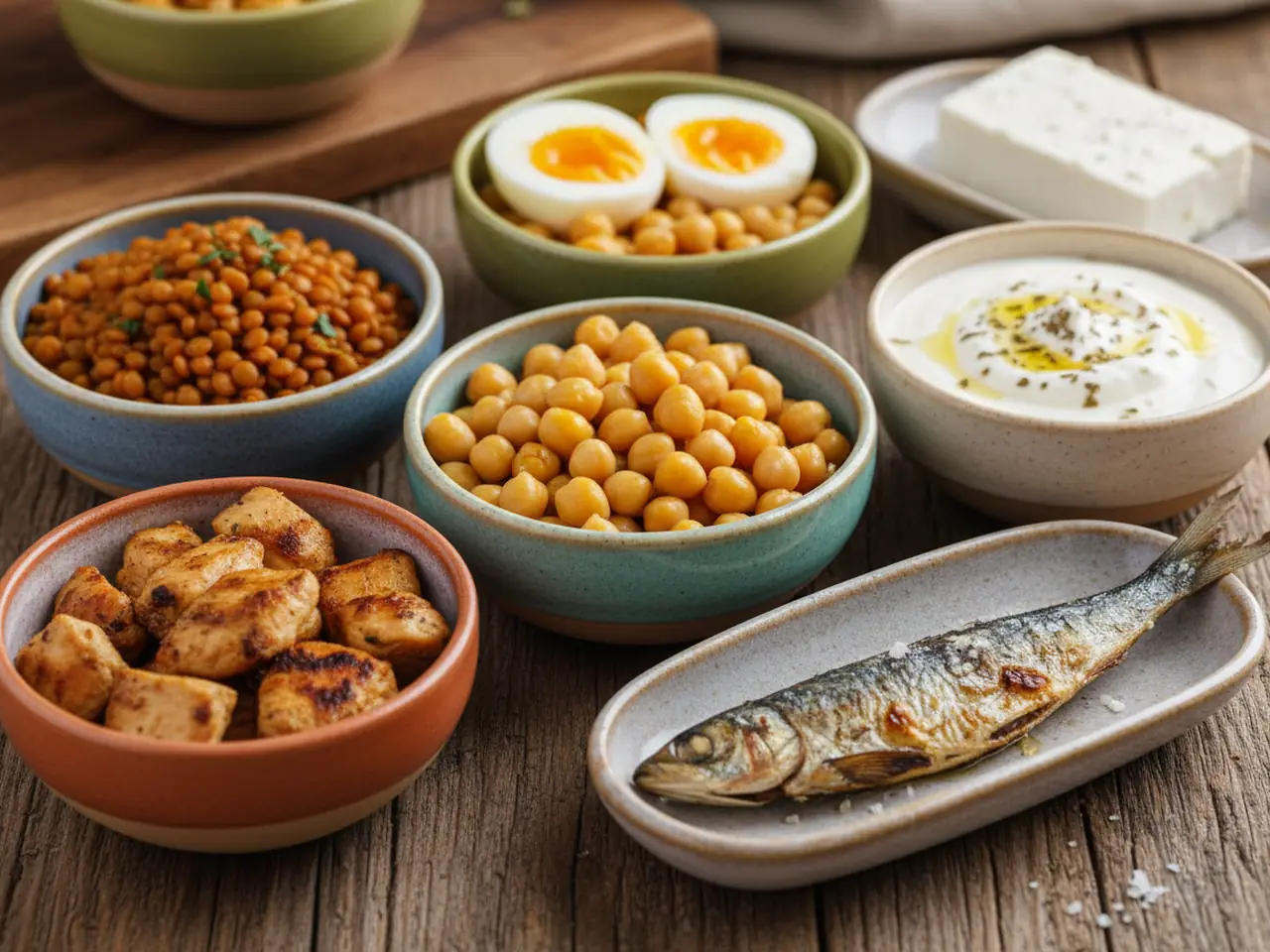
Where to find protein
With values from the app's database, per typical portion:
| Food | Portion | Protein | Energy |
|---|---|---|---|
| Chicken breast (cooked) | 1 portion (120 g) | 36 g | 169 kcal |
| Turkey fillet (cooked) | 1 portion (120 g) | 34 g | 149 kcal |
| Lean minced beef (5% fat, cooked) | 1 portion (120 g) | 31 g | 186 kcal |
| Salmon (cooked) | 1 fillet (130 g) | 29 g | 278 kcal |
| Tuna in water (tinned, drained) | 1 tin (drained) (112 g) | 30 g | 160 kcal |
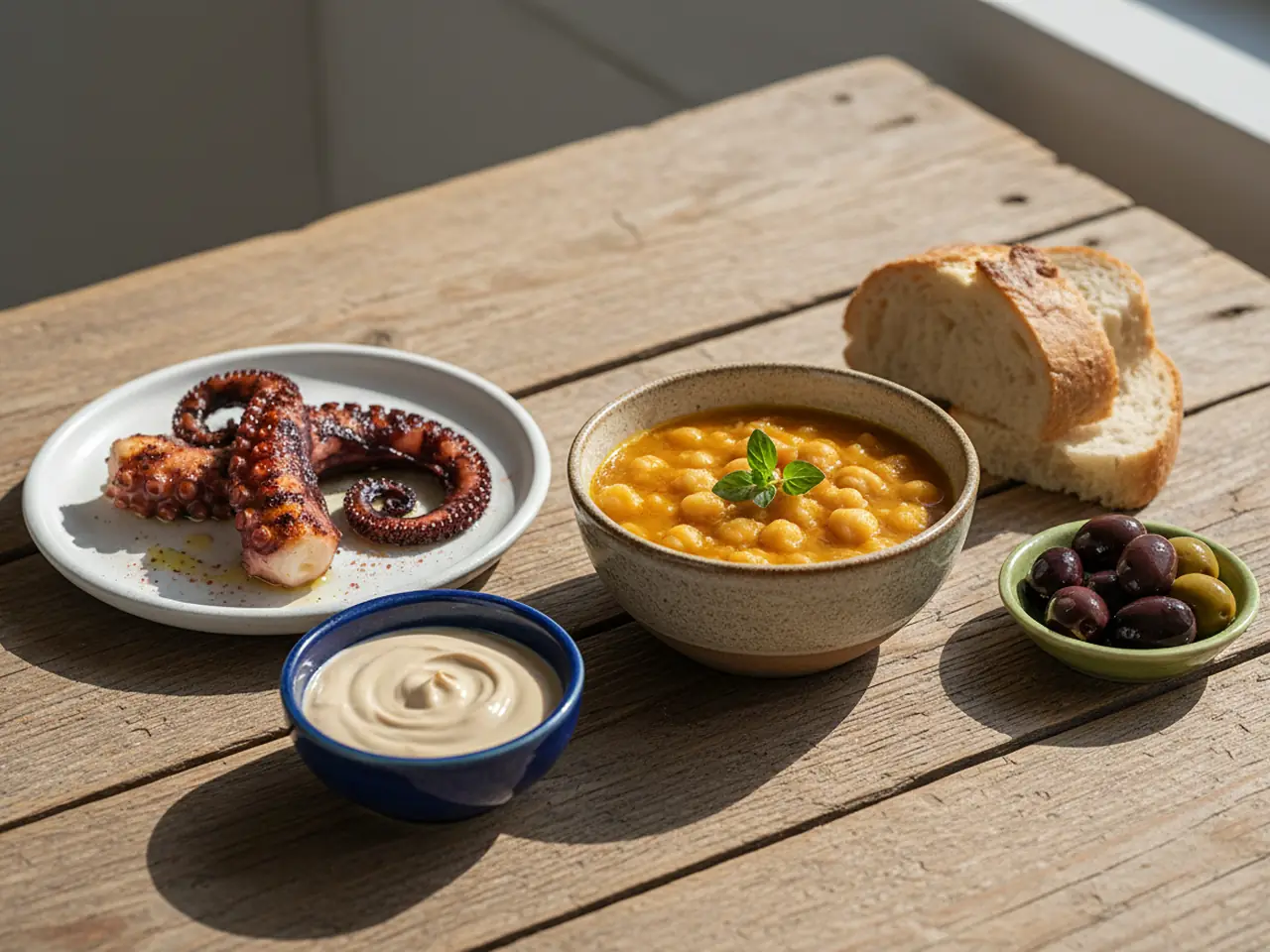
| Octopus (boiled) | 1 portion (150 g) | 45 g | 233 kcal |
| Egg | 1 egg (50 g) | 6.4 g | 70 kcal |
| Strained yoghurt 2% fat | 170 g pot | 17 g | 122 kcal |
| Cottage cheese (1% fat) | 225 g pot | 27 g | 154 kcal |
| Milk 1.5% fat | 1 glass (250 ml) | 8.8 g | 123 kcal |
| Feta | 1 matchbox-sized piece (30 g) | 4.4 g | 85 kcal |
| Lentils (boiled) | 1 cup (200 g) | 20 g | 255 kcal |
| Chickpeas (boiled) | 1 cup (165 g) | 14 g | 244 kcal |
| Almonds | 1 handful (30 g) | 6.8 g | 185 kcal |
| Wholemeal bread | 1 slice (30 g) | 2.9 g | 70 kcal |
| Whey protein (powder) | 1 scoop (30 g) | 23 g | 104 kcal |
Chicken, turkey, fish and seafood give a lot of protein with few calories. Strained (Greek-style) yoghurt and cottage cheese are easy options for breakfast and snacks. Pulses (legumes) give less protein per calorie, but plenty of fibre with it. Tofu has about 15 g of protein per 100 g. Whey protein powder is convenient, but you don't need it if you reach your target with food. For days without meat and dairy, see the article on Orthodox fasting.
Your kidneys
In healthy adults, an analysis of 28 trials with 1,358 people found no difference in kidney function between diets with more protein and diets with a normal amount. The finding is of low certainty.
If you have kidney disease, different rules apply. Talk to your doctor. The international KDIGO guideline of 2024 suggests 0.8 g per kilo for chronic kidney disease stages 3 to 5. It also suggests avoiding high protein, above 1.3 g per kilo, when the disease is at risk of getting worse. The app follows these rules and does not create an automatic weight-loss plan from stage 3 onwards.
After 65
The European ESPEN guideline of 2022 says that older people need at least 1 g of protein per kilo a day. An expert group suggests 1.0 to 1.2, at least 1.2 for those who exercise, and 1.2 to 1.5 for those with an acute or chronic illness. The exception is severe kidney disease without dialysis. If you feel weak or are losing weight without meaning to, talk to your doctor.
Other situations
- Pregnancy and breastfeeding: needs go up, by 1, 9 and 28 g a day in each trimester and by 19 g in the first 6 months of breastfeeding, according to EFSA.
- Under 18: different values apply.
- Cirrhosis or another special diet prescribed by a doctor: follow your doctor's advice.
Sources
- EFSA Panel on Dietetic Products, Nutrition and Allergies (2012). Scientific Opinion on Dietary Reference Values for protein. EFSA Journal 10(2):2557. doi.org
- Institute of Preventive, Environmental and Occupational Medicine (Prolepsis) (2014). Greek National Dietary Guidelines for Adults: scientific evidence base (in Greek). PDF
- Wycherley TP et al. (2012). Effects of energy-restricted high-protein, low-fat compared with standard-protein, low-fat diets: a meta-analysis of randomized controlled trials. American Journal of Clinical Nutrition 96(6):1281-1298. PubMed 23097268
- Ellinger S et al. (2024). Protein intake and body weight, fat mass and waist circumference: an umbrella review of systematic reviews for the evidence-based guideline on protein intake of the German Nutrition Society. European Journal of Nutrition 63(1):3-32. PubMed 37794213
- Leidy HJ et al. (2015). The role of protein in weight loss and maintenance. American Journal of Clinical Nutrition 101(6):1320S-1329S. PubMed 25926512
- Morton RW et al. (2018). A systematic review, meta-analysis and meta-regression of the effect of protein supplementation on resistance training-induced gains in muscle mass and strength in healthy adults. British Journal of Sports Medicine 52(6):376-384. PubMed 28698222
- Longland TM et al. (2016). Higher compared with lower dietary protein during an energy deficit combined with intense exercise promotes greater lean mass gain and fat mass loss. American Journal of Clinical Nutrition 103(3):738-746. PubMed 26817506
- Pasiakos SM et al. (2013). Effects of high-protein diets on fat-free mass and muscle protein synthesis following weight loss: a randomized controlled trial. FASEB Journal 27(9):3837-3847. PubMed 23739654
- Moore DR et al. (2015). Protein ingestion to stimulate myofibrillar protein synthesis requires greater relative protein intakes in healthy older versus younger men. Journals of Gerontology A 70(1):57-62. PubMed 25056502
- Schoenfeld BJ, Aragon AA (2018). How much protein can the body use in a single meal for muscle-building? Implications for daily protein distribution. Journal of the International Society of Sports Nutrition 15:10. PubMed 29497353
- Volkert D et al. (2022). ESPEN practical guideline: Clinical nutrition and hydration in geriatrics. Clinical Nutrition 41(4):958-989. PubMed 35306388
- Bauer J et al. (2013). Evidence-based recommendations for optimal dietary protein intake in older people: a position paper from the PROT-AGE Study Group. Journal of the American Medical Directors Association 14(8):542-559. PubMed 23867520
- KDIGO CKD Work Group (2024). KDIGO 2024 Clinical Practice Guideline for the Evaluation and Management of Chronic Kidney Disease. Kidney International 105(4S):S117-S314. PubMed 38490803
- Devries MC et al. (2018). Changes in kidney function do not differ between healthy adults consuming higher- compared with lower- or normal-protein diets: a systematic review and meta-analysis. Journal of Nutrition 148(11):1760-1775. PubMed 30383278
Last checked: October 2026. This article gives general information for adults and does not replace advice from a doctor or dietitian. If you find a mistake, write to us at info@mesogeafit.com.
The amounts for your own meals
MesogeaFit works out the grams of each meal from your details and corrects them every 2 weeks from your weigh-ins.