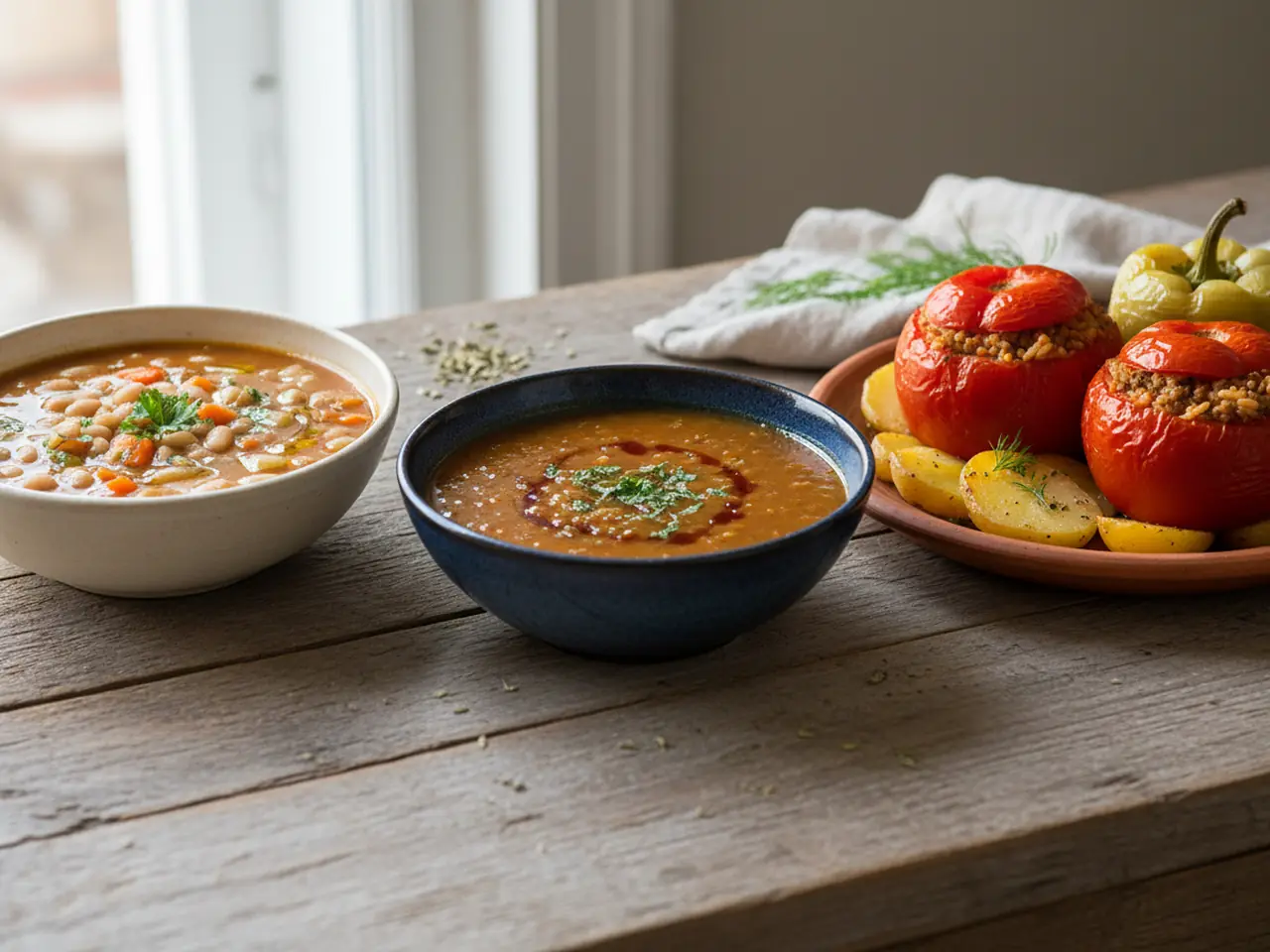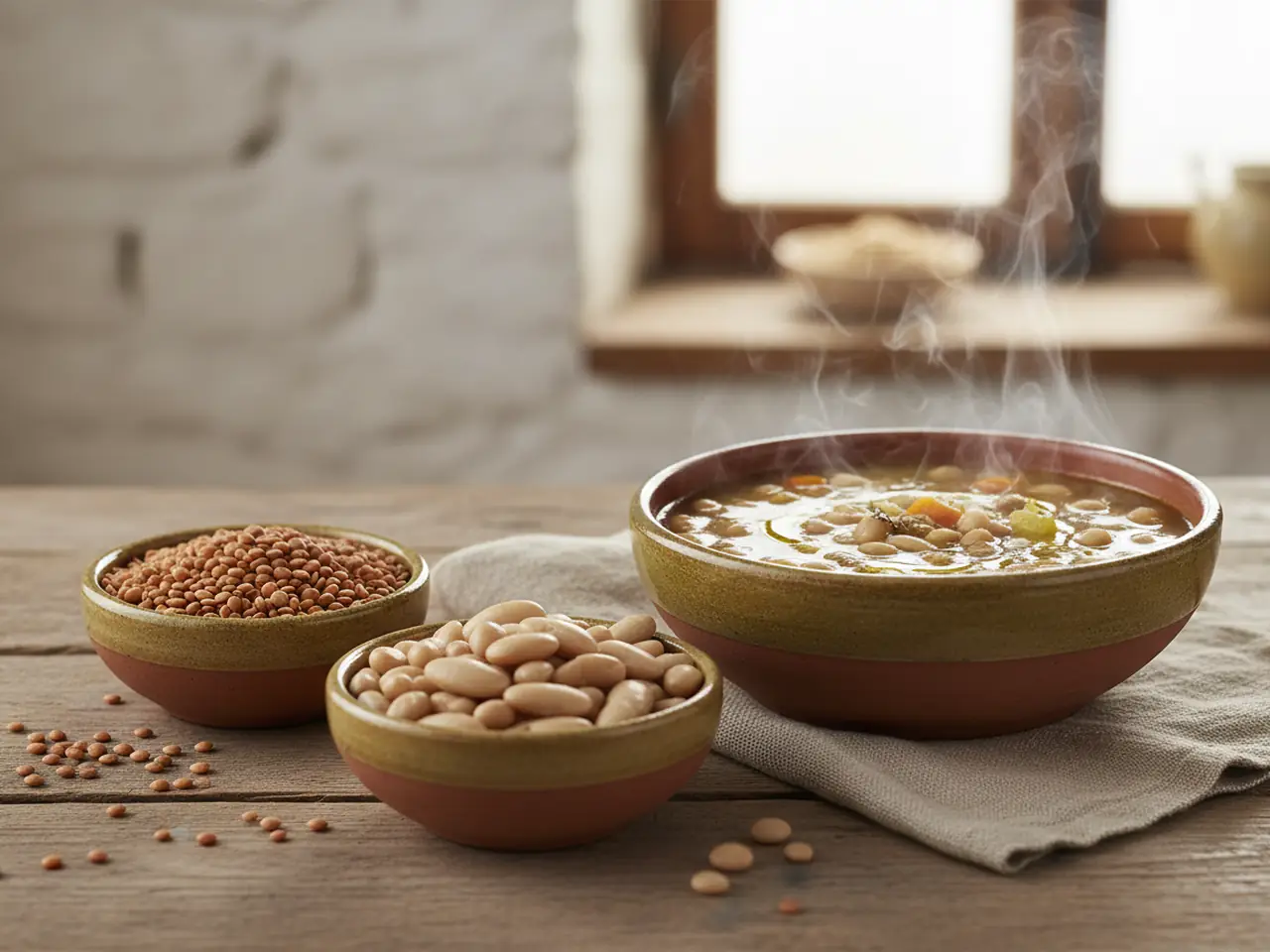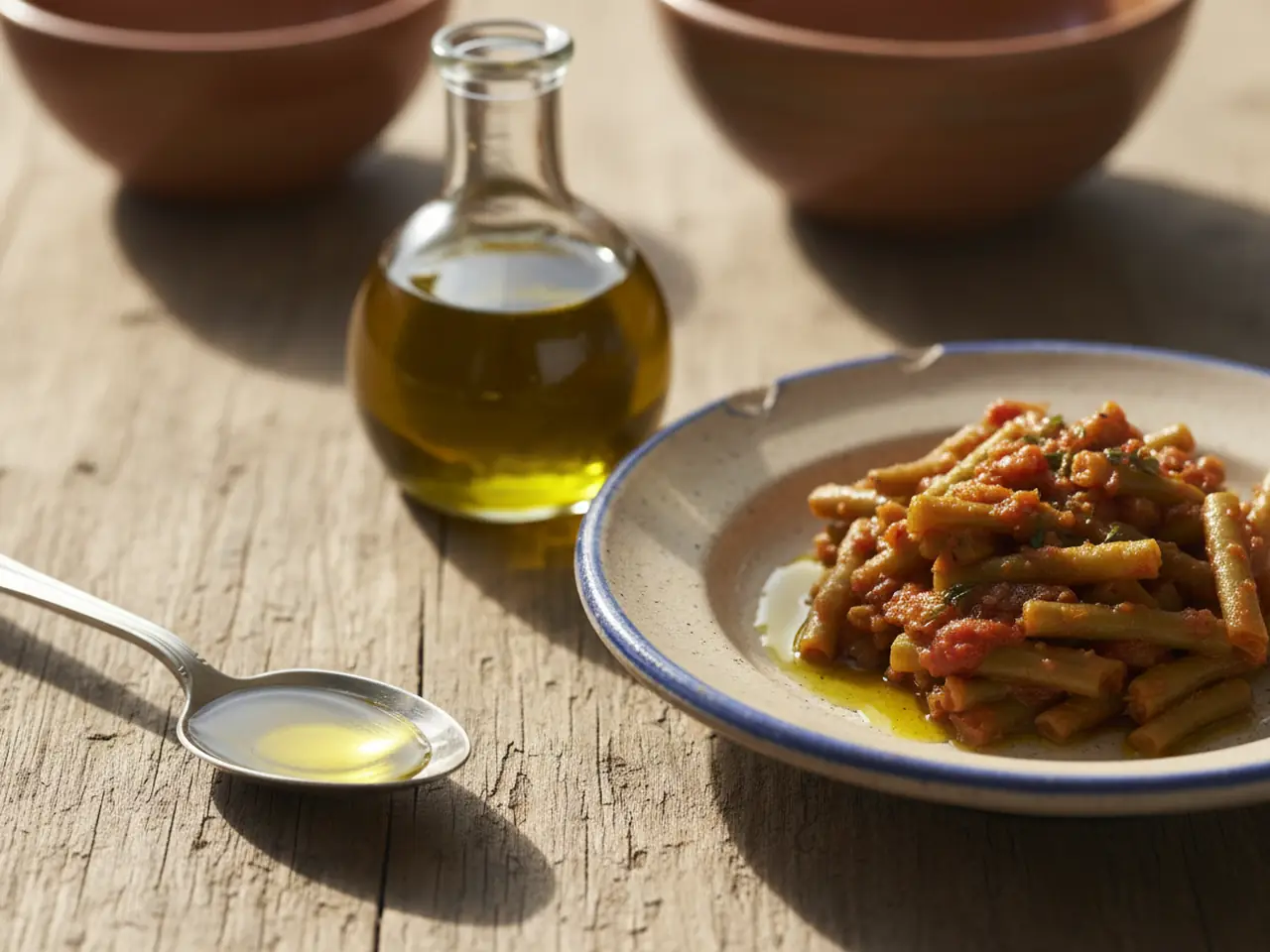
A tablespoon of olive oil (15 ml) weighs about 13.8 g and has 124 kcal. A teaspoon (5 ml) has 41. The app's ladera (vegetables slow-cooked in olive oil) use about one and a third tablespoons per portion, which means 164 kcal from the oil. The Greek National Dietary Guidelines recommend olive oil as the main fat, but it has as many calories as any other oil, so it is worth measuring it with a spoon.
In Greek cooking, olive oil goes into everything, from pulses (legumes) and ladera to salads and bread. It is also the food with the most calories per 100 g on the Greek table, 900 kcal. That is why it is worth knowing how much you use.
How much it weighs and how many calories it has
Olive oil weighs 0.918 g per ml, according to the FAO density database. With kitchen measuring spoons and cups:
| Amount | Grams | Energy |
|---|---|---|
| Teaspoon (5 ml) | 4.6 g | 41 kcal |
| Tablespoon (15 ml) | 13.8 g | 124 kcal |
| A third of a cup (80 ml) | 73 g | 661 kcal |
| Half a cup (120 ml) | 110 g | 992 kcal |
| One cup (240 ml) | 220 g | 1,983 kcal |
These figures are for measuring spoons. Ordinary eating spoons come in different sizes. If you want to be accurate, measure once with a measuring spoon how much the spoon you use holds.
All oils have almost the same calories, because they are almost pure fat. Olive oil differs in the type of fat it contains. About 73% is monounsaturated and 15% saturated.
How much oil you get from a portion of ladera
Work out the oil per portion for your own recipe:
We count a tablespoon of olive oil as 13.8 g and a teaspoon as 4.6 g. Olive oil has 900 kcal per 100 g.
In the app's recipes, the ladera (green beans, okra, peas, roast vegetables and stuffed vegetables) use a third of a cup of oil for 4 portions. Pulse dishes use 3 to 5 tablespoons for the whole pot.
| Dish | Oil per portion | Calories from the oil | Share of the portion's calories |
|---|---|---|---|
| Fasolakia (green beans in olive oil) | 18 g | 164 kcal | 47% |
| Bamies (okra in olive oil) | 18 g | 164 kcal | 62% |
| Arakas (peas in olive oil) | 18 g | 164 kcal | 38% |
| Briam (Greek roast vegetables) | 18 g | 164 kcal | 50% |
| Gemista (stuffed tomatoes and peppers) with potatoes | 18 g | 164 kcal | 32% |
| Fasolada (Greek bean soup) | 11.5 g | 104 kcal | 26% |
| Fakes (lentil soup) | 10 g | 92 kcal | 29% |
| Gigantes plaki (baked giant beans) | 14 g | 124 kcal | 31% |
Our recipes use less oil than many traditional ones. With a cup of oil in the pot, a portion of Fasolakia goes from 348 to 678 kcal. See more examples in the article on the calories in cooked dishes.
What the Greek National Dietary Guidelines say
The Greek National Dietary Guidelines for Adults (2014) say to use olive oil as the first choice, for cooking and in salads, and to prefer extra virgin. They put fats, olives and nuts in the same group, with 4 to 5 portions a day for people of normal weight. One portion is one tablespoon of oil, or 10 to 12 olives, or a handful of nuts.
The same guidelines warn that fats are high in calories and may contribute to weight gain. They suggest not pouring oil straight from the bottle but using a pourer spout, a measuring dispenser or a tablespoon. They also suggest a ladera dish once or twice a week.
Olive oil and weight
The best-known trial on olive oil is the Spanish PREDIMED trial. It included 7,447 people aged 55 to 80 with raised cardiovascular risk. They were randomly split into three groups: a Mediterranean diet with extra virgin olive oil added, a Mediterranean diet with nuts, or advice to eat less fat. They were not asked to cut calories.
- Heart: over about 5 years, the olive oil group had fewer serious cardiovascular events than the group given advice on eating less fat, 3.8% against 4.4%. The finding is fairly certain. The study was republished in corrected form in 2018, and it was partly funded by olive oil and nut producers.
- Weight: over 5 years, those given extra olive oil did not put on more weight than the others. The difference was 0.4 kg less, and it was not statistically significant.
The study shows that olive oil as part of a Mediterranean diet did not add kilos in older people. It does not show that you can use as much as you like when you are trying to lose weight. For younger people on a weight-loss plan, the result is of low certainty, because they were not studied.
The EU claim for polyphenols
The European Union has approved one health claim for olive oil: ‘Olive oil polyphenols contribute to the protection of blood lipids from oxidative stress’. It applies only to olive oil with at least 5 mg of hydroxytyrosol and its derivatives per 20 g. So it does not cover every olive oil. The benefit is stated for 20 g a day, about one and a half tablespoons and 180 kcal. The claim concerns blood lipids and has nothing to do with weight.
How much oil fits into your day
There is no single number for everyone. It depends on the calories you need. As an example, a day with one ladera dish, about one and a third tablespoons, and a salad with two teaspoons, has about 28 g of olive oil and 250 kcal from it. For someone who needs 1,800 kcal, that is 14% of the day.
In the MesogeaFit app, the oil in every recipe is measured and counted in the meal's total. The app never lowers the oil below one teaspoon per meal. If you cook from your own recipe, enter how much oil you use and how many portions you divide it into.
In practice
- Measure oil with a spoon, as the Greek dietary guidelines suggest.
- In a salad, two teaspoons of oil are 83 kcal. Three tablespoons are 372.
- With ladera, follow the amount in the recipe and measure your portions.
- If you take an anticoagulant affected by vitamin K, such as acenocoumarol (Sintrom) or warfarin, note that ladera with spinach and greens contain vitamin K. You don't need to cut them out, but it is best to eat them in steady amounts. Ask your doctor.
Sources
- ANSES (2025). Ciqual food composition table, code 17270 (extra virgin olive oil). ciqual.anses.fr
- FAO/INFOODS (2012). Density Database Version 2.0. PDF
- Institute of Preventive, Environmental and Occupational Medicine (Prolepsis) (2014). Greek National Dietary Guidelines for Adults (in Greek). PDF
- Estruch R et al. (2018). Primary prevention of cardiovascular disease with a Mediterranean diet supplemented with extra-virgin olive oil or nuts. New England Journal of Medicine 378(25):e34. PubMed 29897866
- Estruch R et al. (2019). Effect of a high-fat Mediterranean diet on bodyweight and waist circumference: a prespecified secondary outcomes analysis of the PREDIMED randomised controlled trial. Lancet Diabetes & Endocrinology 7(5):e6-e17. PubMed 31003626
- Regulation (EU) 432/2012 (2012). List of permitted health claims (olive oil polyphenols). EUR-Lex
- EFSA Panel on Dietetic Products, Nutrition and Allergies (2011). Scientific Opinion on the substantiation of health claims related to polyphenols in olive. EFSA Journal 9(4):2033. doi.org
Last checked: October 2026. This article gives general information for adults and does not replace advice from a doctor or dietitian. If you find a mistake, write to us at info@mesogeafit.com.
The amounts for your own meals
MesogeaFit works out the grams of each meal from your details and corrects them every 2 weeks from your weigh-ins.