In studies from the US and the UK, a restaurant meal has on average about 1,000 to 1,300 kcal. There are no measurements for Greek tavernas. Over the festive season adults gain on average 0.4 to 0.9 kg, which often stays. It may help to plan in advance what you will eat and to carry on as normal the next day, without ‘cutting back’ on food.
When you eat out, you don’t know how much oil, cheese and bread is in the dish. Over the festive season, meals like these pile up within a few days. The numbers that follow show what holds true and where you need to take care.
How many calories a meal out has
In the US, restaurant meals have been measured in the laboratory. In the UK, the studies used the calories that chains state on their menus.
| Study | Where | What it found |
|---|---|---|
| Urban 2016 | Restaurants in 3 US cities, laboratory measurement | 1,205 kcal per meal on average. 92% had more energy than a person needs in one meal |
| Urban 2013 | 157 meals in Boston | 1,327 kcal per meal, almost two thirds of a day’s needs |
| Robinson 2018 | 13,396 main dishes in 27 UK chains | 977 kcal on average. Almost half had 1,000 kcal or more |
| Muc 2019 | Starters, sides and desserts in UK chains | Starter 488 kcal, side 398, dessert 431 |
In the study on starters and desserts, drinks were not counted. We found no published measurements for Greek tavernas, so we don’t know whether their meals are bigger or smaller. In the app, when you log a meal out without any other information, we estimate 1,000 to 1,500 kcal. This is an estimate based on the measurements above.
Studies that follow people for years show that people who eat out often tend to weigh more. In a 2012 review, 7 of the 8 studies of this kind found this link. It is an association, and it does not prove that eating out is to blame.
Taverna dishes in numbers
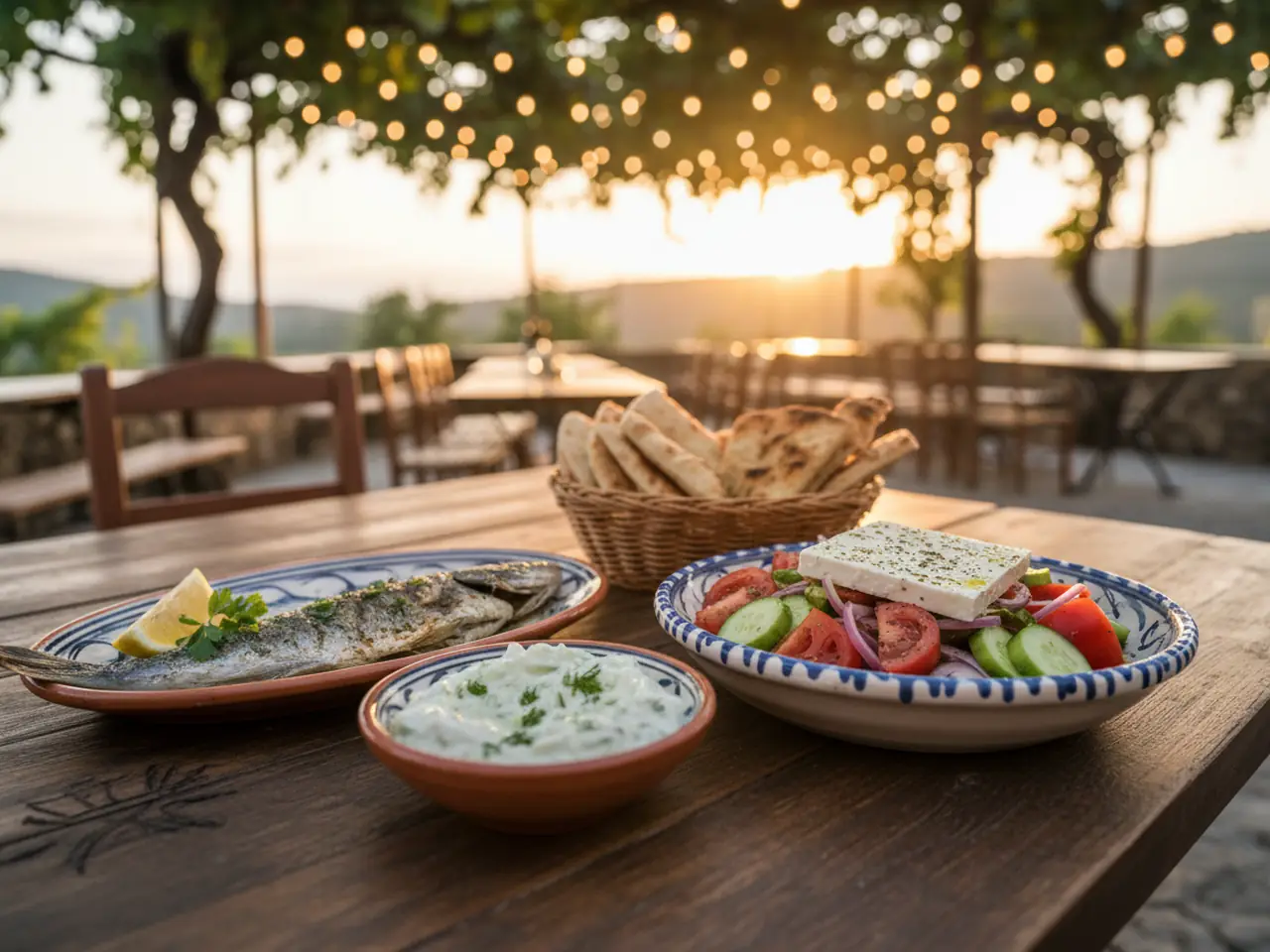
The table shows dishes from the app that resemble taverna orders. They are our own recipes, with measured oil and grilled rather than fried food, so the same dish in a taverna may have more calories. There are no measurements to confirm this.
| Dish (app serving) | Energy | Protein | Salt |
|---|---|---|---|
| Horiatiki (Greek salad) with bread | 465 kcal | 16 g | 2.2 g |
| Chicken skewer with pitta and tzatziki | 456 kcal | 46 g | 1.7 g |
| Fava (yellow split pea purée) with onion, olive oil and bread | 422 kcal | 20 g | 0.4 g |
| Grilled fish with greens and potatoes | 468 kcal | 43 g | 0.4 g |
| Grilled sardines with salad and bread | 396 kcal | 35 g | 0.8 g |
| Grilled squid with salad and bread | 381 kcal | 41 g | 1.9 g |
| Octopus in vinegar with bread and salad | 484 kcal | 56 g | 2.6 g |
| Moussaka with salad | 503 kcal | 29 g | 1.0 g |
| Oven-baked lamb with potatoes | 558 kcal | 42 g | 1.2 g |
| Pastitsio with salad | 676 kcal | 41 g | 1.2 g |
Horiatiki is often seen as a light option. With 50 g of feta, 2 teaspoons of oil and 2 slices of bread, it reaches 465 kcal. It also has 2.2 g of salt, almost half of the 5 g recommended for the whole day. The fish with greens and the fava have similar calories with much less salt.
The small things that add up
In a taverna, calories go up mainly through what is put on the table for everyone.
- Olive oil: each tablespoon has about 124 kcal. A salad with three tablespoons of oil instead of two teaspoons has about 290 kcal more.
- Bread: a 30 g slice of white bread has about 86 kcal. A basket with 4 slices, for example, is about 340.
- Feta: 50 g has 142 kcal. A large 100 g piece on top of a salad, for example, has 284.
- Souvlaki pitta: about 212 kcal each.
- Tzatziki: two tablespoons have about 56 kcal.
- Fried food: chips have 258 kcal per 100 g and fried squid 173, according to the Ciqual database. Boiled potatoes have 81.
A 2015 Cochrane review found that larger portions, packages and plates make people eat more. The finding is fairly certain. In a taverna, this means that the platters in the middle of the table and the constant ‘have some of this too’ count. The same goes for drinks. In experiments, people who drank alcohol with their food ate slightly more (see the article on alcohol).
How much weight we gain over the festive season
- In a US study in 2000, 195 adults gained on average 0.37 kg from mid-November to mid-January. By spring they had not lost it.
- Reviews give an average of 0.4 to 0.9 kg over the festive period. People who already carry extra weight usually gain more.
- In a European study of more than 1,000 people who were trying to maintain their weight, weight rose by 1.35% at Christmas and did not fully come down in the following months.
The festive kilo is small, but it often stays and adds to the next one. The evidence is fairly certain, because many studies find the same.
Weighing yourself the morning after a big meal
If you weigh yourself the morning after a big meal and see 1.5 kg more, most of it is water, salt and carbohydrate stored in your muscles. One kilo of fat takes about 7,700 kcal more than you use. Even a 2,000 kcal meal is about a quarter of that. That is why the app shows the 7-day average as the main number. More in the article on plateaus and weighing.
What helps
Weighing and a plan before the festive season. In a randomised study in the UK in 2018, 272 adults were split into two groups before Christmas. One group weighed themselves regularly, recorded their weight and received tips for the festive season. The other group received only a leaflet. At the end of the festive season, the weight change in the first group was on average half a kilo smaller than in the second. It is one study and it lasted a few weeks, so the result is of low certainty.
‘If… then…’ plans. You decide in advance what you will do at a specific moment. For example, ‘If chips arrive for everyone, then I put a few on my plate and eat the salad first.’ In an analysis of 23 studies, these plans helped a little with eating more healthily. The finding is of low certainty. They helped more with adding something good than with cutting something out.
Calories on the menu. Where the menu shows calories, people may choose about 47 kcal less per meal. The finding is of low certainty. If the menu does not show calories, the numbers in the table above help you make an estimate.
A few ideas for the table, based on the numbers in this article:
- Choose one main dish with protein, such as fish, skewers or pulses, and put the meze on your plate once.
- Ask for the salad with little oil, or add the oil yourself.
- Decide in advance how many slices of bread you will eat.
- If you are going to drink, count the drinks in your plan too.
The next day
Carry on with your normal plan. Don’t ‘skip’ meals to make up for it. The UK study helped through weighing and planning, without deprivation. In MesogeaFit you can set one free meal a week, on any day you like, and talk it through with your advisor before or after.
Take extra care if your doctor has told you to cut down on salt. Dishes like horiatiki and octopus in vinegar with bread give about half the day’s salt in one meal, or more. If you have or have had an eating disorder, talk to your doctor or psychologist about how to handle festive meals.
Sources
- Urban LE et al. (2016). Energy contents of frequently ordered restaurant meals and comparison with human energy requirements and US Department of Agriculture database information: a multisite randomized study. Journal of the Academy of Nutrition and Dietetics 116(4):590-598. PubMed 26803805
- Urban LE et al. (2013). The energy content of restaurant foods without stated calorie information. JAMA Internal Medicine 173(14):1292-1299. PubMed 23700076
- Robinson E et al. (2018). (Over)eating out at major UK restaurant chains: observational study of energy content of main meals. BMJ 363:k4982. PubMed 30541906
- Muc M et al. (2019). A bit or a lot on the side? Observational study of the energy content of starters, sides and desserts in major UK restaurant chains. BMJ Open 9(10):e029679. PubMed 31594875
- Bezerra IN, Curioni C, Sichieri R (2012). Association between eating out of home and body weight. Nutrition Reviews 70(2):65-79. PubMed 22300594
- Hollands GJ et al. (2015). Portion, package or tableware size for changing selection and consumption of food, alcohol and tobacco. Cochrane Database of Systematic Reviews CD011045. PubMed 26368271
- Crockett RA et al. (2018). Nutritional labelling for healthier food or non-alcoholic drink purchasing and consumption. Cochrane Database of Systematic Reviews CD009315. PubMed 29482264
- Yanovski JA et al. (2000). A prospective study of holiday weight gain. New England Journal of Medicine 342(12):861-867. PubMed 10727591
- Schoeller DA (2014). The effect of holiday weight gain on body weight. Physiology & Behavior 134:66-69. PubMed 24662697
- Díaz-Zavala RG et al. (2017). Effect of the holiday season on weight gain: a narrative review. Journal of Obesity 2017:2085136. PubMed 28744374
- Turicchi J et al. (2020). Weekly, seasonal and holiday body weight fluctuation patterns among individuals engaged in a European multi-centre behavioural weight loss maintenance intervention. PLoS One 15(4):e0232152. PubMed 32353079
- Mason F et al. (2018). Effectiveness of a brief behavioural intervention to prevent weight gain over the Christmas holiday period: randomised controlled trial. BMJ 363:k4867. PubMed 30530821
- Adriaanse MA et al. (2011). Do implementation intentions help to eat a healthy diet? A systematic review and meta-analysis of the empirical evidence. Appetite 56(1):183-193. PubMed 21056605
- Kwok A et al. (2019). Effect of alcohol consumption on food energy intake: a systematic review and meta-analysis. British Journal of Nutrition 121(5):481-495. PubMed 30630543
- ANSES (2025). Ciqual food composition table (codes 4032, 10084). ciqual.anses.fr
Last checked: October 2026. This article gives general information for adults and does not replace advice from a doctor or dietitian. If you find a mistake, write to us at info@mesogeafit.com.
The amounts for your own meals
MesogeaFit works out the grams of each meal from your details and corrects them every 2 weeks from your weigh-ins.