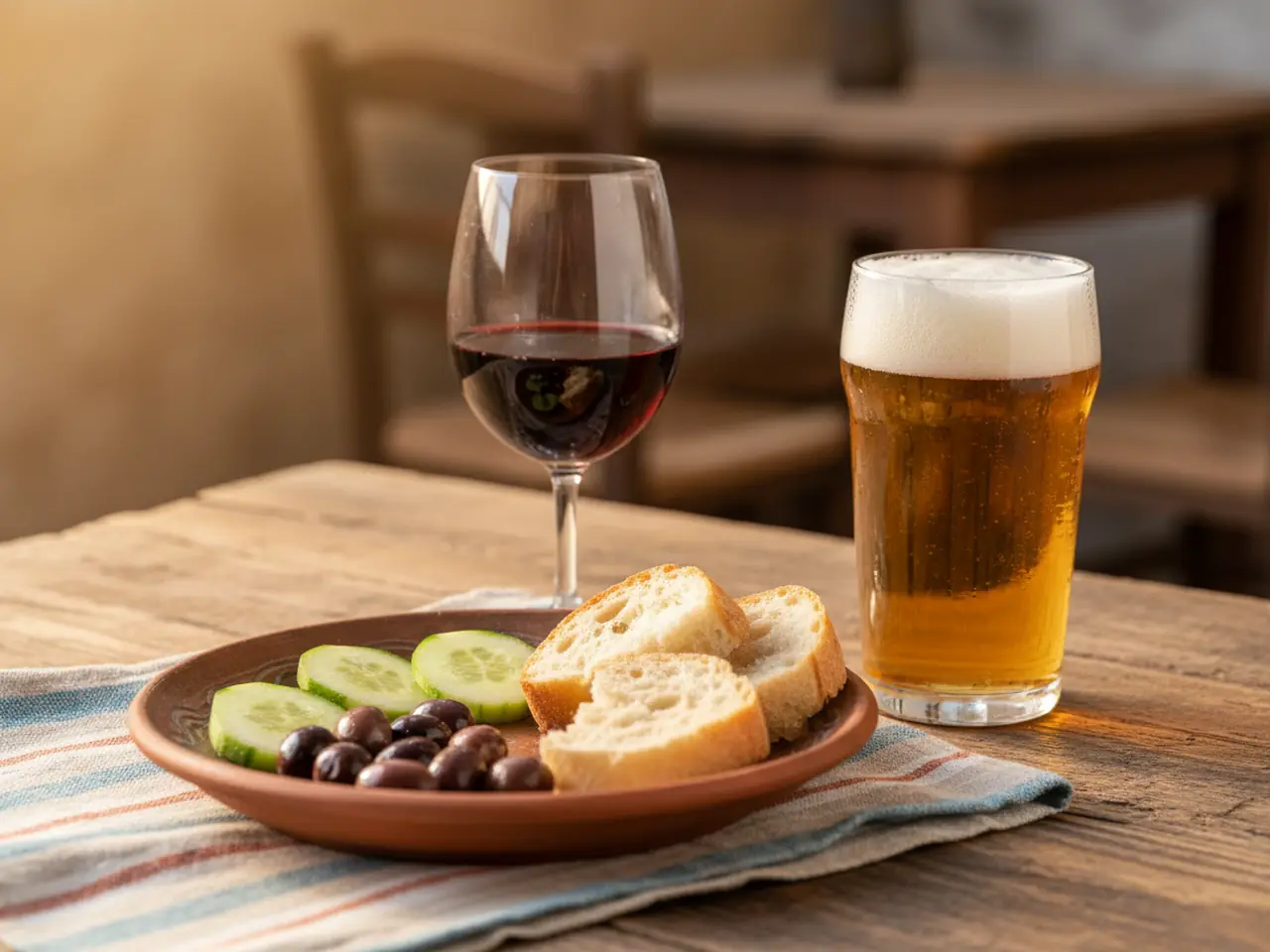
A 330 ml beer has about 140 kcal, a 150 ml glass of dry wine 100 to 110 and a 40 ml glass of tsipouro (grape marc spirit) about 90. In dry wine and tsipouro almost all the energy comes from the alcohol itself. In studies, people who drink with a meal do not eat less to ‘make room’ for the drink. They usually eat slightly more.
An evening with two beers or three 150 ml glasses of wine adds 280 to 330 kcal, as much as a small meal. Below you will find how much energy each drink has, what alcohol does in the body and what research shows about weight and health.
Where the calories come from
Each gram of alcohol provides 7 kcal. That is a little less than fat (9 kcal) and quite a lot more than sugar and protein (4 kcal). This is also the factor used to calculate energy on labels across the European Union.
You work out the grams of alcohol from the ml and the strength of the drink. You multiply the ml by the alcohol percentage and by 0.789, which is the density of ethanol. A 150 ml glass of red wine at 13% has 150 × 0.13 × 0.789 = about 15 g of alcohol, which is about 108 kcal.
In dry wine, ouzo and tsipouro (grape marc spirit), almost all the energy is the alcohol. In the Ciqual database, red wine has no carbohydrate at all. Beer also has carbohydrate from the barley, which is why even non-alcoholic beer has calories. Sugar counts in medium sweet and sweet wines and in the soft drinks that go into mixed drinks.
Calories per glass
The values are for standard glasses. The Greek National Dietary Guidelines count as ‘1 drink’ a 330 ml beer, a 125 ml glass of wine or a 40 to 45 ml glass of ouzo or tsipouro. At home and in bars and restaurants the wine glass is often bigger, so we also give 150 ml.
| Drink | Amount | Alcohol | Energy |
|---|---|---|---|
| Beer 5% | 330 ml | 13 g | about 140 kcal |
| Beer 5% | 500 ml | 20 g | about 210 kcal |
| Non-alcoholic beer | 330 ml | 2 g | about 100 kcal |
| Dry red wine 13% | 150 ml | 15 g | about 108 kcal |
| Dry white wine 12% | 150 ml | 14 g | about 101 kcal |
| Medium sweet wine 11.5% | 150 ml | 14 g | 102 to 122 kcal |
| Ouzo or tsipouro 40% | 40 ml | 13 g | about 90 kcal |
| Small carafe of tsipouro 40% | 200 ml | 63 g | about 440 kcal |
| 40% spirit with sugar-sweetened cola | 40 + 200 ml | 13 g | about 170 kcal |
The values are estimates. Wines and beers come in different strengths, and every place serves differently. Non-alcoholic beer varies a lot from product to product, so check the label.
What happens in the body when you drink
A 1999 study in the US measured what happens after a small amount of alcohol in 8 healthy men. After 24 g of alcohol, about as much as two 125 ml glasses of wine, the amount of fat the whole body used for energy fell by 73% over the following hours. Less than 5% of the alcohol was turned into fat. Most of it became acetate, which the body uses for energy instead of fat.
We cannot say from this study how much weight anyone gains. It was 8 people, measured over a few hours. It does explain, though, why the calories in alcohol count in full, because while the body is breaking down alcohol it uses less fat for energy.
When we drink, we eat more
A 2019 review brought together 22 experiments with 701 adults. On some days they drank alcohol before or with a meal and on other days a drink without alcohol. In the 12 experiments that went into the pooled calculation, with alcohol they ate on average about 80 kcal more food. Together with the drink itself, total energy rose by about 256 kcal on each occasion.
The results are of low certainty. The studies were short, were done in a laboratory and mostly involved young people. They agree, though, with an older review from 2010, which found that the energy in alcohol is added to the energy we get from food.
If I drink a little, will I gain weight?
Long-term studies follow people for years and record how much they drink. People who drink a lot tend to gain weight, a finding of low certainty. For people who drink a little or moderately, the results differ from study to study, so it is uncertain. These studies show an association. They do not prove that drinking is the cause. People who drink a little may also have other habits that help them. So for weight, the only thing we know for certain is the calories. Two beers every evening are about 280 kcal a day, almost 1,950 kcal a week.
Health beyond calories
In recent years official bodies have become stricter about alcohol.
- The World Health Organization states that no amount of alcohol has been found that does not affect health. Alcohol causes cancer, and the risk rises the more a person drinks.
- The European Code Against Cancer (5th edition, 2025) recommends avoiding alcoholic drinks.
- A large 2023 analysis looked at 107 studies with almost 5 million people. Once the errors of older studies were corrected, people who drank a little did not have clearly lower mortality than people who never drank. The finding is fairly certain.
The 2014 Greek National Dietary Guidelines say that if you don’t drink, there is no need to start, and this still holds today. For the same reason we do not give ‘safe limits’ here. The less you drink, the lower the risk.
What the label says
Wines produced from 8 December 2023 onwards must show their energy on the label. The rest of the information may be on a web page, reached through a QR code. Beers and other drinks with more than 1.2% alcohol are not required to show calories. Most non-alcoholic beers have up to 1.2%, so they must carry a nutrition table. For everything else, the values in the table above are a good estimate.
When not to drink at all
- In pregnancy and when you are trying to become pregnant. No safe amount has been found.
- When you are going to drive. On average the body breaks down about 8 g of alcohol an hour. A 125 ml glass of wine has 12 to 13 g, so it takes more than an hour and a half. The rate varies from person to person.
- When you take medicines that do not mix with alcohol. Ask your doctor or pharmacist.
- If you find it hard to stop once you start. Talk to your doctor.
If you are watching your weight, don’t ‘skip’ meals to make room for drinks. Log them as usual and carry on with your plan the next day. In MesogeaFit you log drinks like any other food and see where they leave you for the day. For evenings out, read the article on tavernas and festive meals too.
Sources
- Kwok A et al. (2019). Effect of alcohol consumption on food energy intake: a systematic review and meta-analysis. British Journal of Nutrition 121(5):481-495. PubMed 30630543
- Siler SQ, Neese RA, Hellerstein MK (1999). De novo lipogenesis, lipid kinetics, and whole-body lipid balances in humans after acute alcohol consumption. American Journal of Clinical Nutrition 70(5):928-936. PubMed 10539756
- Yeomans MR (2010). Alcohol, appetite and energy balance: is alcohol intake a risk factor for obesity?. Physiology & Behavior 100(1):82-89. PubMed 20096714
- Traversy G, Chaput JP (2015). Alcohol consumption and obesity: an update. Current Obesity Reports 4(1):122-130. PubMed 25741455
- Zhao J et al. (2023). Association between daily alcohol intake and risk of all-cause mortality: a systematic review and meta-analyses. JAMA Network Open 6(3):e236185. PubMed 37000449
- World Health Organization, Regional Office for Europe (2023). No level of alcohol consumption is safe for our health (press release, 4/1/2023). who.int
- IARC, European Code Against Cancer (5th edition) (2025). Recommendation 6, alcohol consumption. PDF
- Institute of Preventive, Environmental and Occupational Medicine (Prolepsis) (2014). Greek National Dietary Guidelines for Adults (in Greek). diatrofikoiodigoi.gr
- Regulation (EU) No 1169/2011 on the provision of food information to consumers (2011). Article 16(4) and Annex XIV: exemption of beverages containing more than 1.2% alcohol, and energy conversion factors. EUR-Lex
- Regulation (EU) 2021/2117 amending Regulations (EU) No 1308/2013, (EU) No 1151/2012, (EU) No 251/2014 and (EU) No 228/2013 (2021). Labelling of the energy value of wines. EUR-Lex
- UK Chief Medical Officers (2016). Alcohol consumption: advice on low risk drinking (also covers pregnancy). gov.uk
- Commission Delegated Regulation (EU) 2019/33 supplementing Regulation (EU) No 1308/2013 (2019). Annex III, Part B: sugar content limits for dry, medium dry, medium sweet and sweet wines. EUR-Lex
- Regulation (EU) 2019/787 on the definition, description, presentation and labelling of spirit drinks (2019). Annex I, category 6: grape marc spirit (tsipouro, tsikoudia), and the technical file of the GI ‘Ouzo’. EUR-Lex
- NHS (accessed 10/2026). Calculating alcohol units. nhs.uk
- ANSES (2025). Ciqual food composition table (codes 5001, 5030, 5214, 5215, 5216, 18018, 18060). ciqual.anses.fr
- USDA FoodData Central (2018). SR Legacy 174815: Alcoholic beverage, distilled, all (gin, rum, vodka, whiskey) 80 proof. fdc.nal.usda.gov
Last checked: October 2026. This article gives general information for adults and does not replace advice from a doctor or dietitian. If you find a mistake, write to us at info@mesogeafit.com.
The amounts for your own meals
MesogeaFit works out the grams of each meal from your details and corrects them every 2 weeks from your weigh-ins.