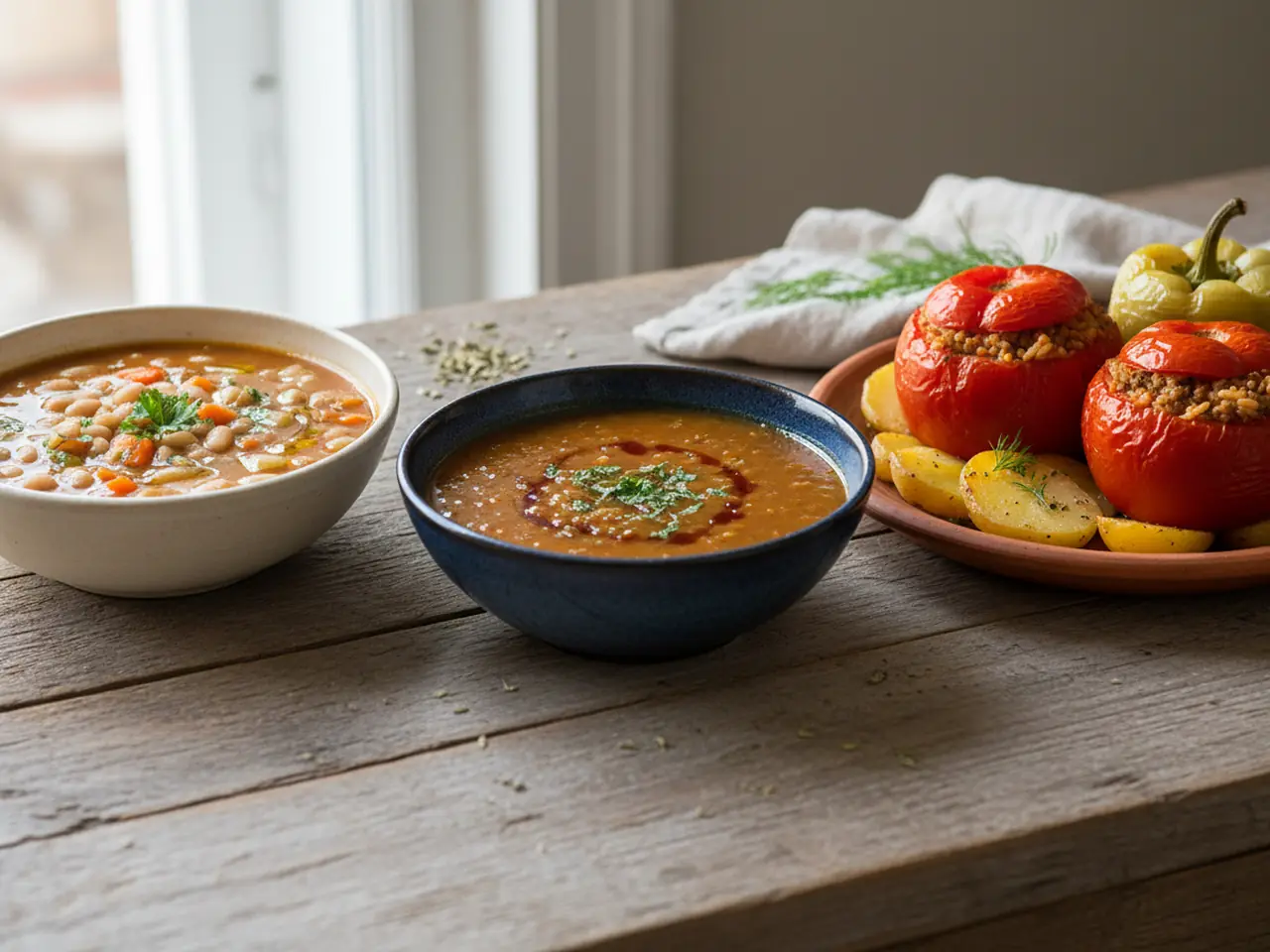
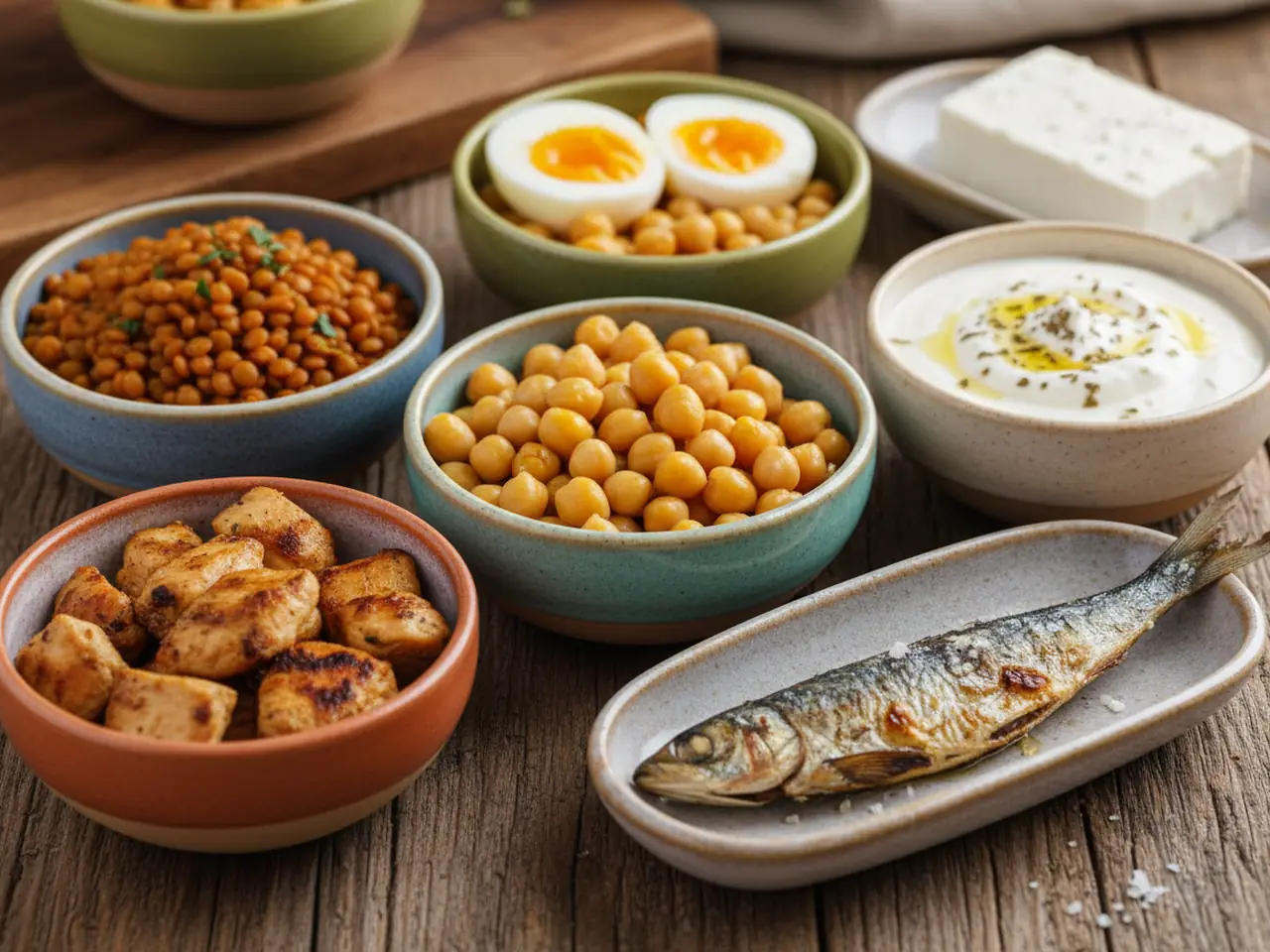
To lose weight you do not need special foods. You need less energy than you use, protein in every main meal and plenty of vegetables, and to measure your oil and bread. Below is an example day with yoghurt, lentils and chicken, about 1,620 kcal and 95 g of protein, for a woman aged 45 weighing 78 kg with an office job. It is an example, not a plan for you. Your own calories depend on your sex, age, weight and activity.
Eating to lose weight needs no special foods or drinks, just ordinary food in amounts that leave a small deficit every day. Here you will see what goes on the plate over the week, an example day with grams, and how to change it to suit you.
What goes on the plate over the week
The Greek National Dietary Guidelines for Adults (2014) give a pattern for the whole week, with recommendations for healthy adults. On a diet you keep the pattern and change the amounts.
| Food group | How often | One portion |
|---|---|---|
| Vegetables | 4 portions a day | 150 to 200 g |
| Fruit | 3 portions a day | 120 to 200 g |
| Milk and dairy | 2 portions a day | 1 glass of milk, 1 yoghurt or 30 g of cheese |
| Pulses | at least 3 a week | 150 to 200 g cooked |
| Fish and seafood | 2 to 3 a week | 150 g cooked |
| White meat | 1 to 2 a week | 120 to 150 g cooked |
| Red meat | up to 1 a week | 120 to 150 g cooked |
| Eggs | up to 4 a week | 1 egg |
The same Guidelines ask for less than 5 g of salt a day.
Vegetables and fruit also help with hunger. In a one-year trial of 97 women with obesity, those who learnt to eat less fat and more fruit and vegetables lost 7.9 kg, against 6.4 for those who only cut down on fat. The figures refer to the women who completed the trial. They ate a larger volume of food and reported less hunger. It is a single trial, so the finding is of low certainty.
An example day
The example is for a woman aged 45, 1.65 m and 78 kg, with an office job and little activity. With the Mifflin-St Jeor equation and a factor of 1.40 for a sedentary life, her maintenance calories come to about 2,000. With a deficit of about 400 kcal, that is 20%, her target is around 1,600 kcal a day (example). This is slightly gentler than the 500 kcal deficit mentioned in the US guidelines. The calories and protein come from the app's food database.
| Meal | What she eats (example) | kcal | Protein |
|---|---|---|---|
| Breakfast | Strained yoghurt 2% fat 150 g, rolled oats 40 g, the kernels of 2 walnuts (10 g), 1 teaspoon of honey, 1 small apple (130 g) | 420 | 21 g |
| Lunch | Fakes (lentil soup) 400 g, 2 slices of wholemeal bread (60 g), feta 30 g | 590 | 29 g |
| Afternoon | 2 mandarins (150 g peeled), 2 wholemeal crispbread toasts | 140 | 3 g |
| Dinner | Grilled chicken, breast 120 g cooked, 3 small boiled potatoes (225 g), salad 200 g with 2 teaspoons of olive oil | 470 | 42 g |
| Total | 1,620 | 95 g |
What the numbers in the example show:
- Protein about 95 g, that is about 1.2 g per kilo. This is above the 0.83 g per kilo that EFSA considers adequate for healthy adults. In an analysis of 24 trials, diets with more protein gave slightly greater fat loss, with evidence of low certainty.
- Fibre about 36 g, mainly from the lentils, the oats and the wholemeal bread. EFSA considers 25 g a day adequate for normal bowel function in adults.
- Salt about 2.7 g from the foods and recipes, not counting salt you add at the table. The Guidelines' target is under 5 g.
- The oil is measured. The lentils in the recipe already contain olive oil, 3 tablespoons for 4 servings, and the salad has 2 teaspoons.
How much energy small amounts hold
The Guidelines suggest measuring olive oil with a spoon or a measuring dispenser rather than pouring it from the bottle. The table shows why:
| Food | Portion | Energy | Protein |
|---|---|---|---|
| Olive oil | 1 tablespoon (14 g) | 124 kcal | 0.0 g |
| Olive oil | 1 teaspoon (4.6 g) | 41 kcal | 0.0 g |
| Wholemeal bread | 1 slice (30 g) | 70 kcal | 2.9 g |
| Feta | 1 matchbox-sized piece (30 g) | 85 kcal | 4.4 g |
| Walnuts | 1 handful (30 g) | 213 kcal | 4.7 g |
| Honey | 1 tablespoon (21 g) | 70 kcal | 0.1 g |
A tablespoon of oil has almost as many calories as the whole afternoon snack in the example. You do not need to cut it out. It is enough to know how much you use. There is more in the article on olive oil.
How to adapt it to your own needs
- If you need more calories, for example if you are a man or more active, the US guidelines give men a target of 1,500 to 1,800 kcal. Add mainly bread, potatoes or rice and a little more protein.
- If you want other dishes, the lentils can be swapped for chickpeas, beans or fava (yellow split pea purée), and the chicken for fish or turkey. Keep the calories per portion similar.
- For the whole week, three lunches with pulses, two with fish, one with chicken and one with red meat cover the Guidelines' pattern.
Breakfast, snacks and how many meals
A 2019 analysis of 13 trials did not find that breakfast helps with weight loss. People who ate breakfast weighed 0.44 kg more on average and ate about 260 kcal more a day, but the trials were short and of low quality. On the number of meals, an analysis of 15 studies found no clear benefit from many small meals, because the positive result came from a single study. Eat on the schedule that suits you. What counts is the total for the day.
Keep a record for a few weeks
A review of 22 studies found that recording your food is consistently linked with greater weight loss, although the evidence is weak. It also helps for another reason. In a small study, 10 people with obesity who said they could not lose weight on fewer than 1,200 kcal recorded on average 47% less food than they actually ate. They were not lying. Portions are hard to judge by eye. One or two weeks with kitchen scales teach you the amounts.
Who needs a different plan
The example is for a healthy adult. If you are pregnant or breastfeeding, are under 18, have or have had an eating disorder, take medicines for diabetes or have chronic kidney, heart or liver disease, talk to your doctor before you change your calories.
If you want the same numbers for your own body and the dishes you like, the MesogeaFit app will work them out for each meal. It is coming soon. Leave your email and we will let you know.
Sources
- Institute of Preventive, Environmental and Occupational Medicine (Prolepsis) (2014). Greek National Dietary Guidelines for Adults (Table 7, salt, advice on olive oil) (in Greek). PDF
- Ello-Martin JA, Roe LS, Ledikwe JH, Beach AM, Rolls BJ (2007). Dietary energy density in the treatment of obesity: a year-long trial comparing 2 weight-loss diets. American Journal of Clinical Nutrition 85(6):1465-1477. PubMed 17556681
- Mifflin MD et al. (1990). A new predictive equation for resting energy expenditure in healthy individuals. American Journal of Clinical Nutrition 51(2):241-247. PubMed 2305711
- Jensen MD et al. (2014). 2013 AHA/ACC/TOS guideline for the management of overweight and obesity in adults. Circulation 129(25 Suppl 2):S102-S138. PubMed 24222017
- EFSA Panel on Dietetic Products, Nutrition and Allergies (2012). Scientific Opinion on Dietary Reference Values for protein. EFSA Journal 10(2):2557. doi.org
- Wycherley TP et al. (2012). Effects of energy-restricted high-protein, low-fat compared with standard-protein, low-fat diets: a meta-analysis of randomized controlled trials. American Journal of Clinical Nutrition 96(6):1281-1298. PubMed 23097268
- EFSA Panel on Dietetic Products, Nutrition and Allergies (2010). Scientific Opinion on Dietary Reference Values for carbohydrates and dietary fibre. EFSA Journal 8(3):1462. doi.org
- Sievert K et al. (2019). Effect of breakfast on weight and energy intake: systematic review and meta-analysis of randomised controlled trials. BMJ 364:l42. PubMed 30700403
- Schoenfeld BJ, Aragon AA, Krieger JW (2015). Effects of meal frequency on weight loss and body composition: a meta-analysis. Nutrition Reviews 73(2):69-82. PubMed 26024494
- Burke LE, Wang J, Sevick MA (2011). Self-monitoring in weight loss: a systematic review of the literature. Journal of the American Dietetic Association 111(1):92-102. PubMed 21185970
- Lichtman SW et al. (1992). Discrepancy between self-reported and actual caloric intake and exercise in obese subjects. New England Journal of Medicine 327(27):1893-1898. PubMed 1454084
Last checked: October 2026. This article gives general information for adults and does not replace advice from a doctor or dietitian. If you find a mistake, write to us at info@mesogeafit.com.
The amounts for your own meals
MesogeaFit works out the grams of each meal from your details and corrects them every 2 weeks from your weigh-ins.