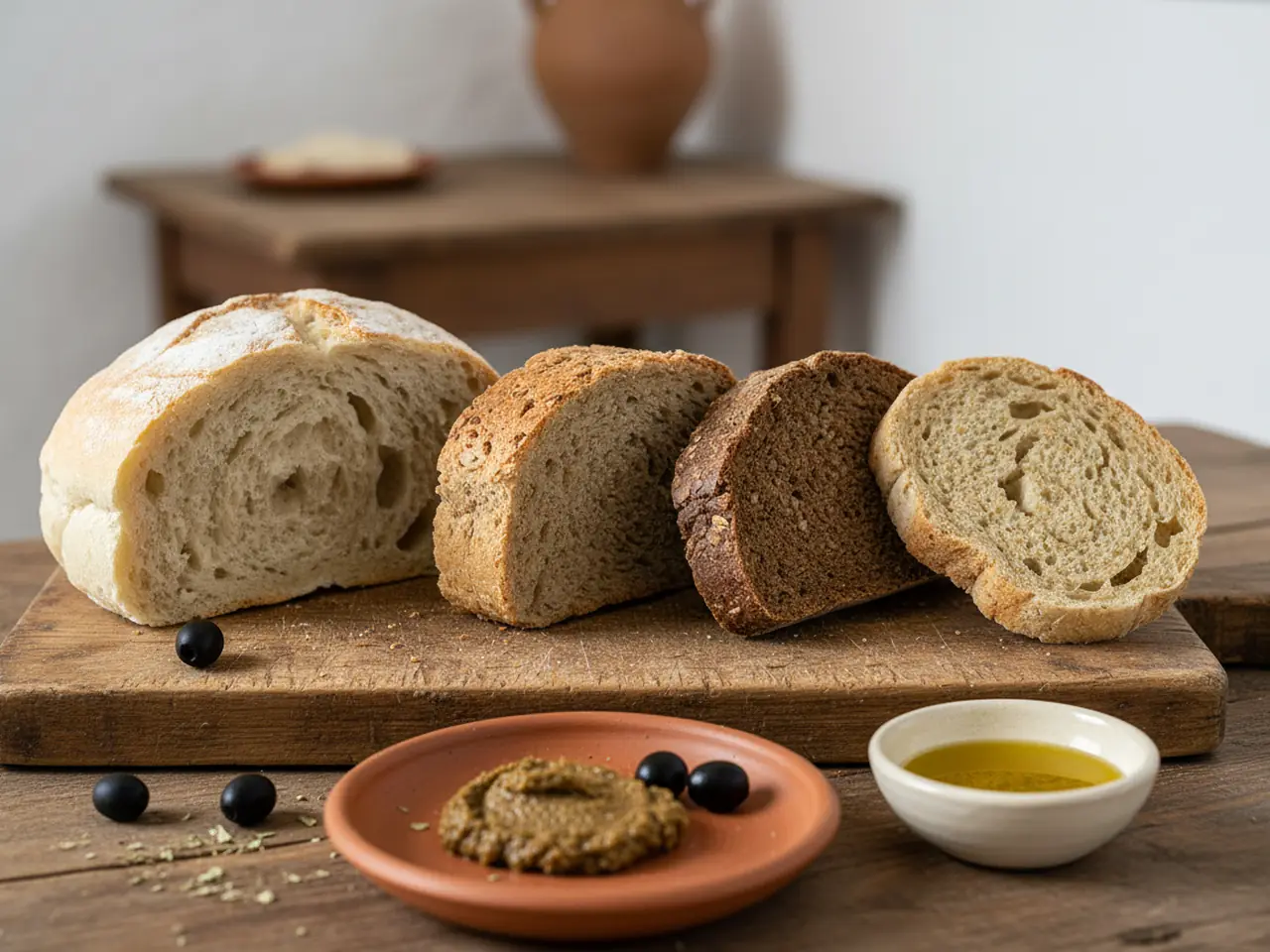
A 30 g slice of bread has 64 to 86 kcal. Wholemeal has about 16 kcal less than white, but its big advantage is fibre, with almost three times as much. A rusk is not ‘lighter’, because it is dried bread, and one large Cretan rusk has as many calories as four slices. In trials, switching from white to wholemeal did not change weight on its own.
At MesogeaFit, bread stays on the table. A slice does not have many calories, and wholemeal bread gives you fibre. The question is which bread and how much.
Calories per slice
With values from the app’s database, for a 30 g slice:
| Bread | Energy | Fibre | Salt |
|---|---|---|---|
| White | 86 kcal | 0.8 g | 0.38 g |
| Wholemeal | 70 kcal | 2.2 g | 0.35 g |
| Wholegrain rye | 64 kcal | 2.5 g | 0.37 g |
| Multigrain | 81 kcal | 1.6 g | 0.34 g |
Wholemeal and rye bread have fewer calories mainly because they hold more water and more fibre. The difference is 16 to 22 kcal per slice, which is not much. The big difference is in fibre. A slice of wholemeal has almost three times as much as a slice of white.
The values are from the French Ciqual database. Breads from Greek bakeries may differ, mainly in salt, as you will see further down.
Rusks and toasts
A rusk is bread that has been baked a second time and has lost its water. That is why, gram for gram, it has more calories. The barley rusk in our database has 3.65 kcal per gram, against 2.34 for wholemeal bread.
| Weight | Energy | Fibre | |
|---|---|---|---|
| 1 slice of wholemeal bread | 30 g | 70 kcal | 2.2 g |
| 2 wholemeal toasts (crispbread) | 18 g | 70 kcal | 2.0 g |
| 1 small barley rusk | 20 g | 73 kcal | 1.5 g |
| 1 large Cretan rusk | 75 g | 274 kcal | 5.6 g |
One small rusk or two toasts equal one slice of bread. One large Cretan rusk equals almost four slices. The Greek National Dietary Guidelines count one slice of bread, two toasts or one medium rusk as one serving of cereals.
What the Dietary Guidelines say
The Greek National Dietary Guidelines for Adults (2014) suggest 5 to 8 servings of cereals a day, depending on your energy needs, with most of them wholegrain. One serving is:
- 1 slice of bread (30 g)
- 2 toasts
- 1 medium-sized rusk
- half a cup of cooked pasta or rice (70 to 90 g)
- half a koulouri (Thessaloniki sesame bread ring)
For bread, the guidelines give two tips about the label. It should say that the bread is wholemeal, and it should have more than 6 g of fibre per 100 g.
What ‘wholemeal’ means
Wholemeal flour contains all parts of the grain: the bran, the germ and the inner part. For bread, though, we did not find a minimum percentage of wholemeal flour in Greek law for it to be called ‘wholemeal’. The same applies in most European countries, according to a European research group that proposed a definition in 2014. An international group of researchers and industry proposes that a product should be called wholegrain when it has at least 30% wholegrain ingredients and more wholegrain than refined ingredients. This is a proposal, not law.
So here is how you check:
- On packaged bread, when the name says ‘wholemeal’, the label must also state the percentage of wholemeal flour. Look at the ingredients.
- Look at the fibre. From 6 g per 100 g upwards, the product may carry the claim ‘high fibre’.
- A dark colour proves nothing. It may come from malt or caramel.
- At the bakery, ask what flour the bread is made with.
What research shows
Health. A large series of analyses in the Lancet in 2019, with 185 observational studies and 58 trials, found that more fibre is linked with a 15% to 30% lower risk of death, heart disease, stroke, type 2 diabetes and colorectal cancer. There were similar findings for whole grains. For fibre the evidence is fairly certain. For whole grains the researchers judged it less certain. Observational studies show an association, not a cause.
Weight. An analysis of 26 randomised trials with 2,060 adults compared wholegrain with refined cereals for up to 16 weeks. It found no difference in weight between the groups. Body fat fell very slightly, by half a percentage point. Long-term observational studies find that people who eat more whole grains gain less weight over the years. But this is an association, and the finding is of low certainty.
So switching from white to wholemeal does not make you lose weight on its own, although it gives you more fibre with slightly fewer calories. What counts for weight is how much bread you eat.
The salt in bread
A Greek study analysed 253 bakery breads from across the country in 2024. They had on average 1.41 g of salt per 100 g, more than in 2012. Only 1 in 5 stayed below the voluntary limit of 1.2% that the Hellenic Food Authority (EFET) and bakers had agreed in 2016. So two slices of bakery bread have about 0.85 g of salt, 17% of the 5 g recommended for the whole day. The breads in our database have 1.06 to 1.25 g, so the bread from your bakery probably has slightly more.
If your doctor has told you to cut down on salt, look for bread with less salt or ask your baker.
Gluten
Rye and barley contain gluten too. European law lists wheat, rye, barley and oats among the allergens. If you have coeliac disease, rye bread and barley rusks are not suitable. You need products labelled ‘gluten-free’.
How much bread
In MesogeaFit meals, bread comes in slices, usually one or two, and its grams are adjusted to the calories of the meal. If you want rusks, dakos (barley rusk with tomato and feta) and barley rusks with anthotyro (fresh whey cheese) are in our recipes with a measured amount. To compare packs, see also the article on the nutrition table.
Sources
- Institute of Preventive, Environmental and Occupational Medicine (Prolepsis) (2014). Greek National Dietary Guidelines for Adults (chapter ‘Cereals’) (in Greek). PDF
- Reynolds A et al. (2019). Carbohydrate quality and human health: a series of systematic reviews and meta-analyses. Lancet 393(10170):434-445. PubMed 30638909
- Pol K et al. (2013). Whole grain and body weight changes in apparently healthy adults: a systematic review and meta-analysis of randomized controlled trials. American Journal of Clinical Nutrition 98(4):872-884. PubMed 23945718
- Ye EQ et al. (2012). Greater whole-grain intake is associated with lower risk of type 2 diabetes, cardiovascular disease, and weight gain. Journal of Nutrition 142(7):1304-1313. PubMed 22649266
- van der Kamp JW et al. (2014). The HEALTHGRAIN definition of 'whole grain'. Food & Nutrition Research 58:22100. PubMed 24505218
- Ross AB et al. (2017). Perspective: a definition for whole-grain food products — recommendations from the Healthgrain Forum. Advances in Nutrition 8(4):525-531. PubMed 28710140
- Marakis G et al. (2025). Voluntary food reformulation initiatives failed to reduce the salt content of artisanal breads in Greece. Nutrients 17(21):3374. PubMed 41228447
- Regulation (EU) No 1169/2011 on the provision of food information to consumers (2011). Article 22 (quantitative indication of ingredients) and Annex II (allergens). EUR-Lex
- Regulation (EC) No 1924/2006 on nutrition and health claims made on foods (2006). Annex: ‘High fibre’. EUR-Lex
- ANSES (2025). Ciqual food composition table (codes 7001, 7110, 7106, 7255, 7340). ciqual.anses.fr
Last checked: October 2026. This article gives general information for adults and does not replace advice from a doctor or dietitian. If you find a mistake, write to us at info@mesogeafit.com.
The amounts for your own meals
MesogeaFit works out the grams of each meal from your details and corrects them every 2 weeks from your weigh-ins.