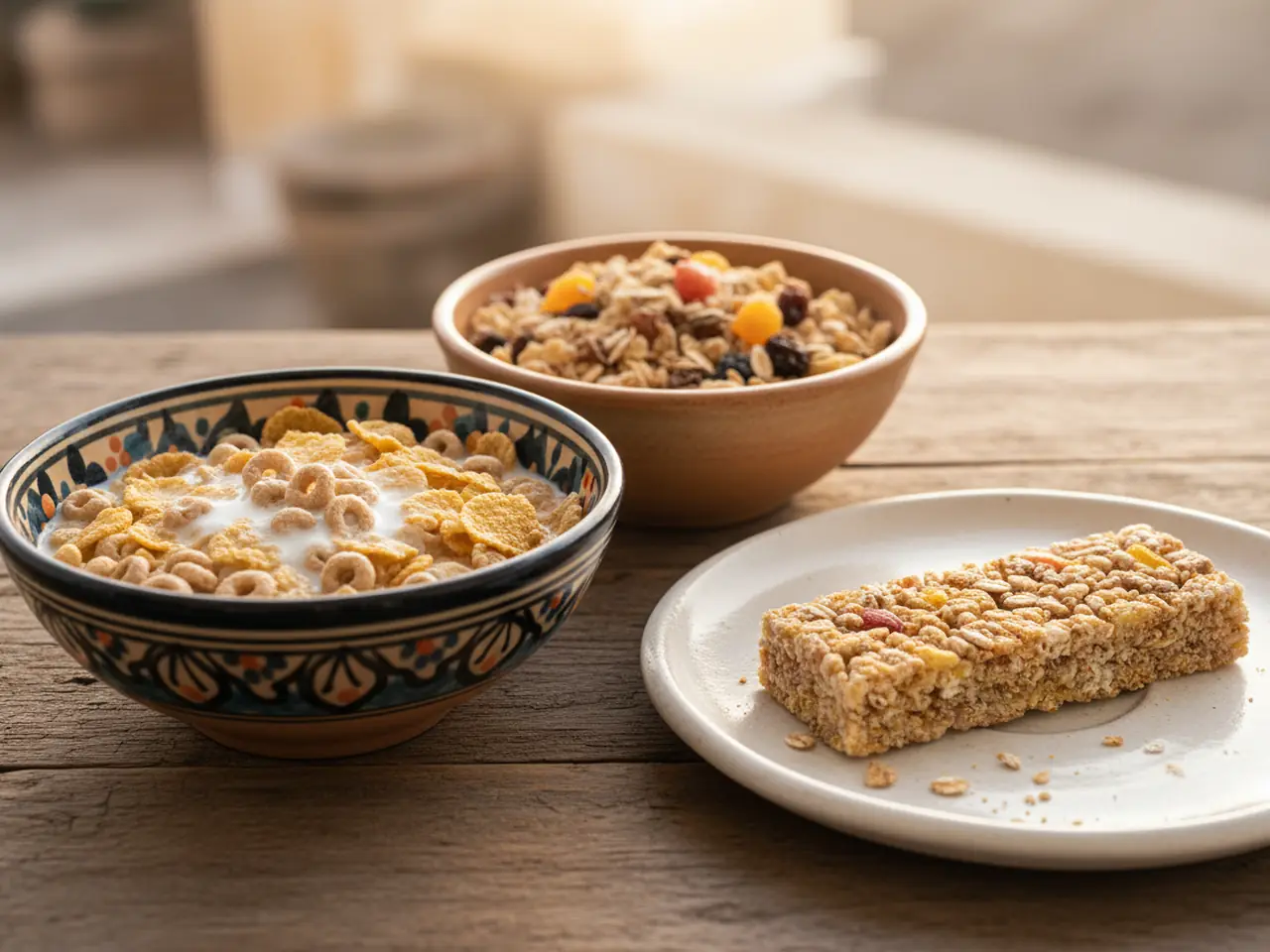
In the five cereals and bars in our database, energy is almost the same, 370 to 380 kcal per 100 g. What changes is sugars, from 1 to 30 g, and fibre, from 4 to 11 g. Look at the sugars per 100 g. Up to 5 g is low and more than 22.5 g is high. ‘Wholegrain’ and ‘no added sugar’ do not on their own mean little sugar.
On the cereal shelf everything looks healthy, with ears of wheat, fruit, ‘wholegrain’ and ‘source of fibre’. The calories per 100 g are almost the same in all of them. The difference lies in sugars and fibre, and you find it in two places on the pack, the nutrition table and the ingredients list.
The numbers
Five foods from the app’s database, per 100 g:
| Food | Energy | Sugars | Fibre | Protein | Salt |
|---|---|---|---|---|---|
| Corn flakes | 368 kcal | 7.6 g | 5.5 g | 6.9 g | 1.0 g |
| Wholegrain breakfast cereal | 369 kcal | 15 g | 9.4 g | 8.5 g | 0.9 g |
| Muesli, no added sugar | 374 kcal | 13 g | 8.9 g | 10 g | 0.0 g |
| Rolled oats | 369 kcal | 1.0 g | 11 g | 11 g | 0.0 g |
| Cereal bar with fruit | 382 kcal | 30 g | 4.1 g | 6.1 g | 0.7 g |
And the same comparison at 30 g, so that you see the same weight. The 30 g is simply the same amount for all of them, not a recommended serving:
| 30 g | Energy | Sugars | Fibre | Colour for sugars |
|---|---|---|---|---|
| Corn flakes | 110 kcal | 2.3 g | 1.6 g | Amber |
| Wholegrain breakfast cereal | 111 kcal | 4.6 g | 2.8 g | Amber |
| Muesli, no added sugar | 112 kcal | 4.0 g | 2.7 g | Amber |
| Rolled oats | 111 kcal | 0.3 g | 3.4 g | Green |
| Cereal bar with fruit | 114 kcal | 9.1 g | 1.2 g | Red |
The colour comes from the sugars per 100 g, with the thresholds of UK labelling: up to 5 g green, up to 22.5 g amber, above 22.5 g red. The values are averages from the Ciqual database. Each product on the shelf may differ, so look at its own table.
‘Wholegrain’ does not mean little sugar
The wholegrain cereal in our database has a lot of fibre, 9.4 g per 100 g. But it also has 15.2 g of sugars, twice as much as corn flakes. Both have quite a lot of salt, 0.9 to 1 g per 100 g, which makes them amber for salt too.
In the regulations we checked, we found no definition of ‘wholegrain’ for breakfast cereals. The word does not guarantee a specific percentage of whole grain, and it says nothing about sugar. That is why you need to look at the table.
Muesli with no added sugar
The muesli in our database has no added sugar, but it has 13.3 g of sugars per 100 g. When a product says ‘with no added sugars’ and contains natural sugars, the law requires it to also say ‘contains naturally occurring sugars’.
Watch the amount too. A cup of muesli weighs about 85 g and has 318 kcal. A cup of corn flakes weighs 30 g and has 110. Muesli is denser, so the same bowl has almost three times the calories.
Cereal bars
The cereal bar with fruit in our database has 30.4 g of sugars per 100 g. It is the only one of the five foods that comes out red. A 25 g bar has 7.6 g of sugars, about one and a half teaspoons, and 95 kcal. It also has only 1.5 g of protein.
Bars vary a lot from product to product. Some contain sweeteners or polyols instead of sugar. They must then say ‘with sweetener(s)’ next to the name. If polyols are above 10%, they also state that excessive consumption may produce laxative effects. In the app, scan the specific bar to see its own colour.
How to find added sugar
The nutrition table shows all sugars together, so the natural sugars of fruit and milk count too. For added sugar, look at the ingredients, which are listed from the largest amount to the smallest. Sugar can appear under various names:
- sugar of any kind
- glucose syrup, glucose-fructose syrup or fructose-glucose syrup
- dextrose, fructose
- invert sugar
- honey
- concentrated fruit juice
The World Health Organization counts all of these, including honey and juices, as ‘free sugars’, which it recommends keeping below 10% of the day’s energy.
When a product has three or four different sugars, each one may sit lower in the list than it would if there were only one. Count how many of these names appear and how high up they are.
Fibre and protein on the pack
| Claim | What it needs |
|---|---|
| Source of fibre | At least 3 g per 100 g or 1.5 g per 100 kcal |
| High fibre | At least 6 g per 100 g or 3 g per 100 kcal |
| Source of protein | At least 12% of energy from protein |
‘Source of fibre’ needs only 3 g. Even the bar in our database reaches it, with 4.1 g. Plain rolled oats, with nothing added, meet all three, with 11.2 g of fibre, 1 g of sugars and 12.4% of energy from protein.
Do breakfast cereals help with weight?
Three reviews find that eating breakfast cereals regularly is linked with a slightly lower body mass index. They rely mainly on observational studies, and all three were commissioned or funded by the cereal industry. The author of one of them writes that cereals may simply go along with a healthier lifestyle. It is uncertain whether the cereals themselves change weight.
A 2019 analysis of 13 randomised trials in the BMJ looked at whether eating breakfast helps. People who ate breakfast had on average 260 kcal more per day and slightly higher weight than those who skipped it. The trials were short, so the finding is of low certainty. It does show, though, that breakfast is not necessary for weight loss. If you like breakfast, have it. If not, you don’t need to force yourself.
How to choose
- Look at the sugars per 100 g. Below 5 g is low, above 22.5 g is high.
- Look at the fibre. 6 g or more is a lot.
- Read the first ingredients and count the names of sugar.
- Weigh your bowl once, so you know how many grams you eat.
If you want something sweet, a bowl of rolled oats with milk and a piece of fruit gives you sweetness from the fruit and fibre from the oats. See the recipe oats with milk and fruit and the article on the nutrition table.
Sources
- Regulation (EU) No 1169/2011 on the provision of food information to consumers (2011). Articles 18 and 30, Annexes I and III. EUR-Lex
- Regulation (EC) No 1924/2006 on nutrition and health claims made on foods (2006). Nutrition claims: Annex (fibre, protein, sugars). EUR-Lex
- Council Directive 2001/111/EC (2001). Relating to certain sugars intended for human consumption. EUR-Lex
- Department of Health (United Kingdom) (2016). Guide to creating a front of pack (FoP) nutrition label for pre-packed products sold through retail outlets. gov.uk
- World Health Organization (2015). Guideline: Sugars intake for adults and children. who.int
- Sievert K et al. (2019). Effect of breakfast on weight and energy intake: systematic review and meta-analysis of randomised controlled trials. BMJ 364:l42. PubMed 30700403
- de la Hunty A, Gibson S, Ashwell M (2013). Does regular breakfast cereal consumption help children and adolescents stay slimmer? A systematic review and meta-analysis. Obesity Facts 6(1):70-85. PubMed 23466487
- Derbyshire EJ, Ruxton CHS (2025). A systematic review of evidence on the role of ready-to-eat cereals in diet and non-communicable disease prevention. Nutrients 17(10):1680. PubMed 40431420
- Williams PG (2014). The benefits of breakfast cereal consumption: a systematic review of the evidence base. Advances in Nutrition 5(5):636S-673S. PubMed 25225349
- ANSES (2025). Ciqual food composition table (codes 32005, 32036, 32113, 32140, 31101). ciqual.anses.fr
Last checked: October 2026. This article gives general information for adults and does not replace advice from a doctor or dietitian. If you find a mistake, write to us at info@mesogeafit.com.
The amounts for your own meals
MesogeaFit works out the grams of each meal from your details and corrects them every 2 weeks from your weigh-ins.